
Economic shifts affecting holiday shopping in Indian Country
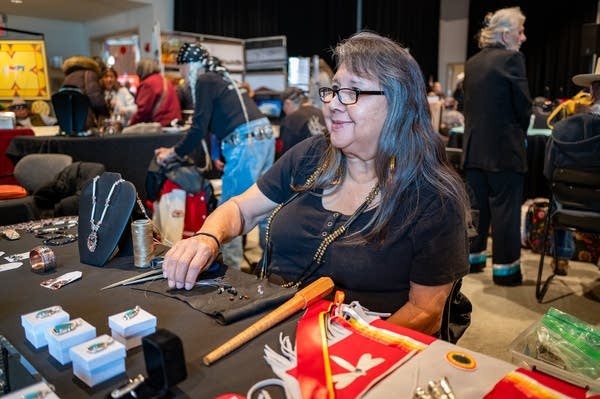
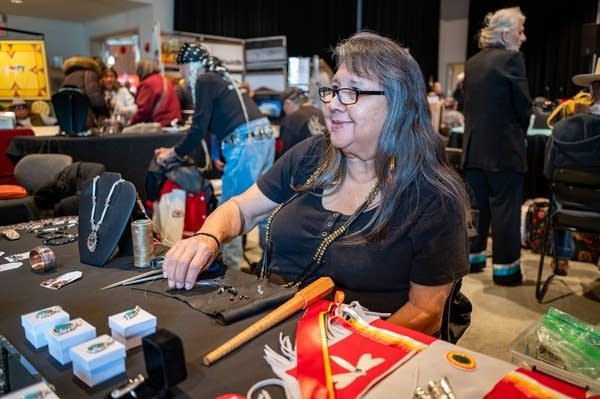
By Amelia Schafer, ICTBarton Brewer sat at a small table in the Dahl Art Center with weeks of work set out in front of him. Earrings carved from elk antlers lined his table, earrings that the retired Oglala Lakota veteran spent hours crafting. Saturday was the first time Brewer ever vended, not just at the Black Hills Indian Art Market but ever. “(I like) the freedom and the joy it gives me it brings me to see that, wow, I created this and someone likes it,” Brewer said. “And then I think, ‘Well, if I like it, then hopefully someone else does.’ And then when they buy them, then that just tells me that they like it, too.”Just before noon on the second day of the market, Brewer had already sold more than 20 of the 55 pairs of elk antler earrings he made, something he said he honestly hadn’t expected to do at his first ever sale.By offering unique or rare items, like Brewer’s antler earrings, small and micro-businesses can differentiate themselves from big box stores and appeal to more customers especially as holiday spending declines across the country.After 11 months of constantly changing tariffs rates on overseas goods under the Trump administration, a roughly 4 percent unemployment rate nationwide the United States economy has taken a hit in 2025. As of November, roughly half of states were in a recession, according to an analysis by Moody’s, a global company that provides data and analytical tools for financial leaders and businesses. Barton Brewer, Oglala Lakota, sold pairs of handmade elk antler earrings at the Black Hills Winter Indian Market on Dec. 7. Amelia Schafer | ICTThose states in a recession include Washington state, Oklahoma, South Dakota, Montana, Kansas, Minnesota, Oregon, and Virginia. Alaska, California, New Mexico, and Nevada are “treading water” right now while states like Arizona, North Dakota, and Idaho are seeing economic growth. All are states with high American Indian and Alaska Native populations, according to the 2020 Census. Moody’s chief economist told “Fortune” that lower-income households are “hanging on by their fingertips financially.” Small businesses are starting to feel a decline in usual holiday sales, said a representative from the Small Business Majority, a United States advocacy group for small businesses. “Several have told us that sales are slower than normal so far because of generally low consumer confidence,” said Simon Brown, director of public relations for Small Business Majority. Tariffs are impacting not just how businesses price their goods, but how accessible it is to keep items in stock. For Indigenous artisans, tariffs impact how much it costs to produce a handmade item in turn increasing how much it is to sell that item. Indigenous artists across the U.S. and Canada have reported experiencing price increases in items like beads, ribbon, fabric and jingle cones.“Since it now costs more to stock up on many items, small businesses have to decide if they want to take the risk of buying as they normally would because unsold inventory — particularly seasonal items — will be a bigger loss than normal,” Brown said.Following Black Friday and Small Business Saturday, there hasn’t been much relief for businesses as consumers aren’t spending what they usually do. “It seems to be a slower Christmas (shopping season),” said Jade Blankenship, an entrepreneur and a citizen of the Confederated Tribes of the Colville Reservation and of Eastern Band of Cherokee descent. Blankenship and her sister own and operate Indigenous Boutique and Spa located in Cherokee, North Carolina, where they sell unique Indigenous crafted items in addition to general spa and massage services. Carving out a nicheThis holiday season customers are purchasing essential items like clothing more, Blankenship said.The shop recently began offering sweatshirts with Indigenous floral prints made by a family friend. The sweatshirts have really taken off with their customer base, Blankenship said.“Our locals, they don’t want to buy a $45 sweatshirt they can probably get cheaper on Shein but they do want to buy a $60 (locally made) Indigenous floral sweater,” Blankenship said. By offering unique items you can’t find anywhere else, Blankenship has carved out a niche in not just her local community but also among non-Native tourists. “That’s why we’ve kind of created those sweatshirts and carry merchandise that sparks conversations within Indigenous communities and non-Indigenous communities,” she said. “We live in a more touristy place that has lots of foot traffic. But if you’re a local, I want you to come support me as well.”Aside from locally designed clothingwear, Blankenship offers a gifting service for customers using their provided gift budget. She then curates a unique gift box in house for them to simplify holiday shopping.Jean Roach, Mnicoujou Lakota, sells jewelry at the Black Hills Winter Market in Rapid City on Dec. 7.Amelia Schafer | ICT“All you have to do is come pay the invoice and pick the gifts up,” she said. While spending in general may have taken a hit, some microbusinesses are finding that customers are still spending – they’re just spending differently, said Angel Fox Starr, owner of Fox Way Designs.A microbusiness is a business with less than 10 employees or in Fox Starr’s case it’s just her and a friend running her vendor booth.“I hear it (a resistance to spend) mostly from the older generation,” Fox Starr, an Arikara citizen of the Three Affiliated Tribes and of Omaha and Odawa descent said. “That’s who’s going to talk about it.”Barton Brewer, Oglala Lakota, creates unique handmade earrings carved from elk antlers.Amelia Schafer | ICTBut when it comes to younger generations, consumers are more inclined to buy a high ticket item like a pair of $80 hand-beaded earrings. “The younger ones are just like, ‘Oh, money comes and goes. This is pretty. I’ll get it. Treat yourself,’” she said. “It’s a treat yourself mentality.”Fox Way Designs, Fox Starr’s business, is a full-time job. After creating new items at her home outside Chicago, she brings the items to her various vending gigs across the country.Handmade items are time consuming and pricey to create and in the face of less holiday spending and more demand for cheap items Indigenous artists need to stay strong and charge what the item is worth, she said.“I made this myself, I didn’t hire somebody for pennies to make it and I profited off of it,” she said. “This is a lot of work. I’m at a point where I am comfortable being able to see that now. But five, six years ago, I wasn’t able to. I didn’t feel comfortable saying that or I would put my prices are way lower.” Fox Starr does offer inexpensive items at her booth like Native-print stuffed animals, and more often than not these have saved her when it comes to making a profit.For vendor businesses like Fox Starr’s, a high-booth price just to sell at a venue can really affect whether or not she even considers setting up there.Last year she traveled from Chicago to the southwest to sell at a major holiday market. On top travel and lodging costs, the booth fee was $400 and she only ended up selling two items, she said. This winter she’s become more selective where she sells, finding that conferences often don’t bring an income for vendors like herself. “People are just there for the conference,” she said. “They’re not planning on spending money. They’re there for work.”At one conference in Rapid City, South Dakota, in early 2025, Fox Starr said vendors witnessed little to no foot traffic at their booths and ended up buying from each other.“I don’t think I even made my booth fee back,” she said. Weighing the costsFor vendors, it’s crucial to sell enough money to actually make a profit. Vendors like Fox Starr travel across the U.S. to attend different events. They need to be mindful of costs across the board: gas, lodging, food, and booth fees usually required to vend. Some Indigenous markets can cost $200 to $400 per day to host a booth. The numbers can really add up. Duwana Two Bulls, founder and coordinator of the biannual Black Hills Indian Market, said this is something she is extremely conscious of when planning. “We keep it low simply because we want them to make money,” Two Bulls, Oglala Lakota and Northern Cheyenne, said. “We’re not in this for the money, we’re here for support.”A customer tries on a skirt by Bountiful Rei’s during the Black Hills Indian Market on Dec. 7 in Rapid City, South Dakota. Amelia Schafer | ICTTwo Bulls started the market in the winter of 2021 to give Indigenous artists a local space to sell their products on their terms.“It was the end of the pandemic and everybody was still, you know, being careful,artists needed an outlet, they couldn’t sell,” she said. “All they had was wholesale, they wereselling to different stores and galleries and things like that, but we wanted them to make some money to pay their bills and connect them directly with their consumer or their buyer.”The vending fee for operating a booth at the Black Hills Indian Market is $30 per day. Significantly lower than the average vending fee at similar markets, Two Bulls said. The 2025 winter market was two days, a first for the organization, but to keep the fees affordable Two Bulls said artists were charged only $50 for the two days. By selling just one pair of earrings for $30, Brewer had already made back what he spent in a day’s worth of table fees. By selling several with such an affordable table fee, he could easily pay back the cost of gas for the roughly 80-mile trip from Oglala to Rapid City.And that’s the goal of the market, Two Bulls said. It’s all about platforming and uplifting Indigenous artists in turn helping them generate a little more income before Christmas, she said. “They can have a Christmas, they can pay those bills, or whatever they need to pay,” she said. “They’re always happy.” Trends and standing outTwo Bulls herself is in touch with fashion trends, aside from the market she also hosts regular fashion shows in the Black Hills community to help Indigenous models and designers get their work in front of an audience.One thing she’s noticed is that dentalium shell earrings and necklaces have really emerged as a sought after item this year, she said. “People are making the more traditional earrings,” she said. “That’s what it started out with, you know, the four tier. And then people started decorating those, you know, putting flower motifs on them and winding beadwork through them and just different things. Dentalium is such a versatile shell.”Dentalium shells are long while tubular shells originating from a marine mollusk found along the northwest coast called a scaphopod. The shells have been a staple Indigenous jewelry for centuries, most commonly along the west coast where they’re harvested from, but through Indigenous trade networks they spread across much of North America, being found as far east as Great Lakes in Ojibwe designs. Bill Brien, Ojibwe and Dakota, of Bismarck, North Dakota, poses for a photo at his booth at the Black Hills Winter Market on Dec. 7 in Rapid City, South Dakota. Brien creates floral Ojibwe and Dakota designs using his cellphone which he then sells on clothing and as prints.Amelia Schafer | ICTIt’s important for small and microbusinesses to have their finger on the pulse of what trends or styles are popular, said Bill Brien, the owner of Bountiful Rei’s, a clothing and graphic design company. Bountiful Rei’s is known primarily for their distinct Native floral print fashion. The most popular item the brand offers are Indigenous floral print skirts with pockets sewn in. Brien, who is Turtle Mountain Ojibwe and Spirit Lake Dakota, commonly vends at conferences and events across North America including the 2025 Black Hills Winter Market. One thing he recently picked up on is customers wanting shorter skirt options rather than the usual default maxi skirt the brand offers. “It’s just about listening,” he said. “A lot of the maxi skirts that I have, they’re pretty long. I have tall clients and short clients. So I listened, and then I started coming out with the mini skirts as a result of just listening and they’ve really taken off.”Brien said he’s also noticed current fashion trends include women wearing shorter skirts with knee high boots, and by picking up on and following these trends he’s been able to continue to cater to the wants and needs of customers. Both online shopping trends and fashion trends are constantly changing, and one way to stand out is by being as unique as possible and offering services customers can’t get anywhere else, said Jade Blankenship.“Anyone can go to Target or to Walmart or all these different places and purchase individual things themselves, but if you’re creating not only something to drive sales but to have convenience for your customer, that’s different,” Blankenship said. “That’s innovation.”Creating to connect For small businesses, and businesses in general, paying attention to trends in addition to just standing out in general can be key to ensuring sales in a shifting economy. For many Indigenous people, vending or operating a microbusiness is their main form of income, but for others like Brewer, it’s a way to connect with community members and get your art in front of people. Barton Brewer sells a pair of earrings to a customer at the Black Hills Indian Winter Market on Dec. 7 in Rapid City, South Dakota.Amelia Schafer | ICTFor the Oglala Lakota elder and retiree, it allows him to keep himself busy and craft items he’s passionate about from his own home shop on the Pine Ridge Reservation in southwestern South Dakota. At the end of the day making art is calming, he said. It’s fun and it simply gives him something to do. Brewer said he wakes up at around 5:30 a.m., brews a cup of coffee and then maps out what he’s going to create. He aims to create three to five pairs of earrings every day over a span of three to four hours a day.“If I’m having a long day I’ll go walk around and look at the art (in my shop) and I just love the different textures, the colors and the way it just comes to life,” he said. “ It talks to me, it really makes me feel calm…I want to try to do that. I want to put something out there that maybe talks to someone.”
已发布: 2025-12-12 17:29:00
来源: www.mprnews.org