
Ranking each of the first 59 Super Bowls: A Giants win is No. 1 but probably not what you’d expect
No other game defines a sport like the Super Bowl defines professional football. In what has become sports’ single biggest spectacle, the Super Bowl has defined careers while hosting some of the world’s most thrilling games, moments and individual performances.The Super Bowl has also had its share of blowouts and dreadful performances, but those games shouldn’t be overlooked. Each one included a memorable moment or performance. As we prepare to celebrate the Super Bowl’s 60th anniversary, every Super Bowl, regardless of score, has played a role into the NFL today.Below is a ranking of the first 59 Super Bowls — a list that also serves as a guide through the history of the biggest event in sports. The criteria used to compile this list is as follows:How competitive was the game from start to finish?What were the memorable plays, moments and performances?What was it’s historical impact?59. Super Bowl XXXV (2001): Ravens 35, Giants 7Unless you were a Ravens fan, this was a brutal game to watch.The only excitement was three touchdowns in a 36-second span that included back-to-back kickoff returns for scores — the first and only time that has happened in a Super Bowl — by the Giants’ Ron Dixon (97 yards) and the Ravens’ Jermaine Lewis (84) yards. There was also a record 22 combined punts.
Fittingly, the MVP went to Ray Lewis, who was the leader of an historically dominant Ravens defense.While mostly a snoozer, Super Bowl XXXV did include back-to-back kickoff returns for scores, the later courtesy of Ravens return ace Jermaine Lewis.
Getty Images
58. Super Bowl XLVIII (2014): Seahawks 43, Broncos 8If this game wasn’t over at halftime, it was after Percy Harvin ran the second-half kickoff 87 yards for a score that increased Seattle’s lead to 29-0.The Seahawks’ dominance — especially against Peyton Manning and the Broncos’ high-scoring offense — was impressive, but the fact that the game was never competitive made it one of the most boring Super Bowls ever.
Malcolm Smith and Seattle’s defense outscored Denver’s record-setting offense in one of the most unexpected Super Bowl outcomes.
Getty Images
57. Super Bowl XXIV (1990): 49ers 55, Broncos 10Why is the biggest margin of victory in Super Bowl history not ranked lower? Because it included a Super Bowl record for points (55) and a then-Super Bowl record five touchdown passes from Joe Montana, who captured his then-record third Super Bowl MVP.It was also the culmination of the 49ers’ dynasty that included four Super Bowl wins over a nine-year span.This game was also a showcase of arguably the NFL’s greatest QB-WR duo ever. In two Super Bowls together, Montana and Jerry Rice connected on 17 completions for 363 yards and four touchdowns.
Rice and Montana were all smiles after winning back-to-back Super Bowls.
Getty Images
56. Super Bowl XX (1986): Bears 46, Patriots 10While it wasn’t at all close (it was, at the time, the biggest blowout in Super Bowl history), this Super Bowl continues to resonate.It not only remains the Bears’ only Super Bowl win — it was won by one of the most iconic teams in NFL history, a team that had big personalities and seven future Hall of Famers. It included the legendary 46 defense led by fiery defensive coordinator Buddy Ryan, who was carried off the field alongside coach Mike Ditka.The game’s signature play is also its most controversial. With the game in hand, the Bears gave the ball to William “Refrigerator” Perry, a 6-foot-2, 335-pound defensive tackle. Perry’s bulldozing touchdown lives on in Super Bowl lore, but it came at the expense of Walter Payton, the franchise’s greatest player who was hoping to score a touchdown on football’s biggest stage.
Chicago’s defense capped off its legendary season by giving beloved defensive coordinator Buddy Ryan the ride of his life.
Getty Images
55. Super Bowl LIX (2025): Eagles 40, Chiefs 22Philadelphia put an emphatic end to the Chiefs’ quest to become the first team to win three straight Super Bowls.Kansas City did a good job containing 2,000-yard rusher Saquon Barkley (who had just 57 yards on 25 carries), but they didn’t do much else on either side of the ball. Jalen Hurts had an MVP performance that included touchdowns in the air and on the ground.Philadelphia’s defense constantly hounded Patrick Mahomes, whose two picks late in the first half effectively iced the game.
Kansas City focused on containing Barkley and taking their chances with Hurts. This was the end result.
Getty Images
54. Super Bowl XXVII (1993): Cowboys 52, Bills 17Another Super Bowl in which the game is more memorable than the score would indicate.It was the Cowboys’ first of three Super Bowl wins in the 90s and the final Super Bowl played at the iconic Rose Bowl. Michael Jackson performed the halftime show, and the Cowboys received all-time performances from Troy Aikman (273 yards and four touchdowns on 22-of-30 passing) and a defense that forced a Super Bowl-record nine turnovers.Oddly, the game’s signature play occurred after the final points had been scored, when Cowboys defensive lineman Leon Lett — who had scooped up a fumble in Cowboys territory — was chased down by Bills wideout Don Beebe just short of the goal line.
Beebe’s hustle prevented the Cowboys from setting the Super Bowl record for points scored.
Getty Images
53. Super Bowl VIII (1974): Dolphins 24, Vikings 7Miami led 24-0 through three quarters before coasting to a 17-point win. The Dolphins became the second team to win back-to-back Super Bowls while compiling a two-year record of 32-2.Larry Csonka won Super Bowl MVP after rushing for a then-Super Bowl record of 145 yards and two touchdowns. One of his scores nearly ended with him crashing into the goal post. This was the final game where the goal posts were stationed in the front of the end zone.A goal post was the only thing that nearly stopped Csonka during his record-setting Super Bowl.
Imagn Images
52. Super Bowl XII (1978): Cowboys 27, Broncos 10While the game was a dud, this Super Bowl is still notable for several reasons. It was the first Super Bowl played indoors (inside the Superdome) and is still the only Super Bowl with co-MVPs after Cowboys defenders Randy White and Harvey Martin shared the award.
This was also the first Super Bowl where a quarterback (Craig Morton) faced a team he had previous led to a Super Bowl. Unfortunately for Morton, he was no match for the Cowboys’ “Doomsday” defense that allowed just 61 yards on 8-of-25 passing.Dallas put the game away on a 45-yard touchdown “catch” by Butch Johnson that wouldn’t have counted in today’s game.White and Martin remain the only co-MVPs in Super Bowl history.
Getty Images
51. Super Bowl XXXIII (1999): Broncos 34, Falcons 19Everyone expected to see defending-champion Denver face the Vikings, who went 15-1 during the regular season, in what could have been an epic matchup. Instead, the Broncos laid waste to the Falcons after Atlanta upset Minnesota in the NFC Championship.
The Falcons were determined to not let league MVP Terrell Davis beat them. Davis still managed ran for 102 yards, but John Elway, who rode off into the sunset after winning MVP honors, dominated the game. Elway threw for 336 yards and totaled two touchdowns in his final game.Elway cracks a joke with Mark Schlereth after scoring his final NFL touchdown.
Getty Images
50. Super Bowl LV (2021): Buccaneers 31, Chiefs 9While Tom Brady’s’s previous eight Super Bowls came down to the wire, his final Super Bowl was a laugher. Brady played a role in Tampa Bay’s dominance, throwing three touchdowns that included two to his longtime teammate, Rob Gronkowski.While Brady won his fifth Super Bowl MVP, his counterpart, Patrick Mahomes, spent his entire night trying to outrun the Buccaneers’ pass rush. The constant pursuit led to some breathtaking plays by Mahomes but very few points for the Chiefs, who were unable to prevent the Buccaneers from becoming the first team to win a Super Bowl on their home field.
Brady’s seventh Super Bowl win was his first as a member of a wild card team. Brady further made history by becoming the first starting quarterback to win a Super Bowl at his home stadium.
Getty Images
49. Super Bowl II (1968): Packers 33, Raiders 14The significance of this game is that it was Vince Lombardi’s final as the Packers’ coach — and the final title won during Green Bay’s 1960s dynasty.The game itself was a forgettable, predicable affair that mirrored the Packers’ Super Bowl I dominance. Bart Starr, as he had the year before, won MVP.Lombardi remains the last coach to lead his team to three consecutive NFL titles. Green Bay won the NFL title each year from 1965-67 in addition to winning the first two Super Bowls.
Getty Images
48. Super Bowl XV (1981): Raiders 27, Eagles 10Led by the resurgence of quarterback Jim Plunkett, a former No. 1 overall pick who went 13-2 as the starter that season after coming off the bench, the Cinderella Raiders were the first wild card team to win the Super Bowl.Plunkett won Super Bowl MVP while linebacker Rod Martin set a Super Bowl record that still stands after he picked off Eagles quarterback Ron Jaworski three times.Rod Martin picked off two passes during the 1980 season before recording a “hat trick” in Super Bowl XV.
Imagn Images
47. Super Bowl XXXVII (2003): Buccaneers 48, Raiders 21 The Buccaneers had a clear advantage in this game: Tampa Bay coach Jon Gruden, whom the Raiders traded from Oakland before the season. Gruden knew the Raiders’ offense like the back of his hand.Tampa Bay also made unofficial history by being the last Super Bowl team to run every single offensive play from under center. The Buccaneers’ offense was led by Michael Pittman, who rumbled for 124 yards on 29 carries. Quarterback Brad Johnson threw a pair of red zone touchdowns to crafty veteran wideout Keenan McCardell.The Raiders’ offense received some late-game magic from 40-year-old Jerry Rice, whose 48-yard touchdown late in the fourth quarter gave the Raiders a glimmer of hope that was quickly extinguished by Tampa Bay’s defense after it recorded two of its three pick-sixes of league MVP Rich Gannon, whom the Buccaneers intercepted a Super Bowl-record five times.A year after coaching the Raiders, Gruden defeated his former team on football’s biggest stage.
Getty Images
46. Super Bowl XXII (1988): Washington 42, Broncos 10Trailing 10-0 after the first quarter, Washington scored 35 points in the second quarter, a Super Bowl record for points in a quarter that may never be broken.The three main players during Washington’s historic quarter were Doug Williams, Timmy Smith and Ricky Sanders. Williams, the first Black starting quarterback to win the Super Bowl, threw four touchdowns that included two to Sanders, whose 193 receiving yards were a single-game Super Bowl record.Williams scored one of his two touchdowns during the quarter and finished the game with a Super Bowl-record 204 rushing yards. Williams’ 340 passing yards were also a single-game Super Bowl record.Williams and Smith (No. 36) spearheaded the highest-scoring quarter in Super Bowl history.
Getty Images
45. Super Bowl VI (1972): Cowboys 24, Dolphins 3The Cowboys’ first Super Bowl win came in convincing fashion as the Dolphins became the first team in the game’s history not to score a touchdown. Longtime Cowboy Bob Lilly made his own history by sacking Bob Griese for a 29-yard loss, the most yards lost on a single play in Super Bowl history.Roger Staubach won Super Bowl MVP (throwing touchdown passes to future Hall of Famers Mike Ditka and Lance Alworth), but the award easily could have gone to running back Duane Thomas, who ran for 95 of the Cowboys’ 252 yards.Dallas went 13-0 that season with Staubach at quarterback.Landry’s decision to move forward with Staubach as his QB1 midway through the 1971 season changed his and the Cowboys’ fortunes.
Getty Images
44. Super Bowl XXVI (1992): Washington 37, Bills 24The game started with Bills running back Thurman Thomas misplacing his helmet, and things deteriorated from there for Buffalo as they trailed 24-0 before finally getting on the scoreboard three minutes into the third quarter.Mark Rypien (291 yards and two touchdowns) won Super Bowl MVP as Joe Gibbs became the first coach to win three Super Bowls with three different quarterbacks.Washington receivers Gary Clark (pictured) and Art Monk torched Buffalo’s defense while becoming the third pair of teammates to each have over 100 receiving yards in a Super Bowl.
Getty Images
43. Super Bowl XXIX (1995): 49ers 49, Chargers 26 From an individual standpoint, it doesn’t get much better than Steve Young’s performance against a tough Chargers defense that was led by Hall of Famer Junior Seau. Young threw for 325 yards and a Super Bowl-record six touchdown passes. He was also the first quarterback to lead both teams in rushing in the Super Bowl with 49 yards on just five carries as San Francisco became the first team to win five Super Bowls.The 49ers enjoyed yet another dominant Super Bowl by Jerry Rice, who caught 10 passes for 149 yards and three touchdowns. Teammate Ricky Watters became joined Rice and former 49ers running back Roger Craig as the only players to score three touchdowns in a Super Bowl.Young’s masterful Super Bowl performance capped off a three-year run that also saw him win league MVPs.
Getty Images
42. Super Bowl XXVIII (1984): Raiders 38, Washington 9In the Super Bowl’s biggest upset since the Jets’ win over the Colts, the Raiders dominated the defending Super Bowl champions from start to finish. Ahead 14-3, the Raiders essentially put the game on ice when Jack Squirek recorded a stunning pick-six just before halftime.Washington was worn down in the second half by Marcus Allen, who won MVP after rushing for a then-record 191 yards. His memorable day included an iconic 74-yard touchdown run that stood as the longest run in Super Bowl history for 22 years.While both of his Super Bowl records have been broken, Allen still has the second-most rushing yards in a Super Bowl and the second-longest touchdown run in Super Bowl history.
Getty Images
41. Super Bowl I (1967): Packers 35, Chiefs 10Green Bay held a precarious 14-10 lead at halftime before Willie Wood’s 50-yard interception return early in the second half opened the floodgates. Bart Starr won MVP, but the real star of the game was 34-year-old backup wideout Max McGee, who partied all night before an injury to starter Boyd Dowler early in the game forced him into action.McGree caught seven passes for 138 yards and two scores that included the first touchdown in Super Bowl history.After catching four passes for 91 yards during the regular season, McGee pulled down seven passes for 138 yards and two scores in Super Bowl I.
Getty Images
40. Super Bowl XIX (1985): 49ers 38, Dolphins 16While the game wasn’t close, this Super Bowl nonetheless featured the greatest quarterback matchup in Super Bowl history in Joe Montana and Dan Marino.Marino, who enjoyed a truly historic 1984 season (he threw for 5,084 yards and 48 touchdowns during the season, which were both single-season records), threw for 318 yards, which was tied for the second-highest total in Super Bowl history. But he was upstaged by Montana, who threw for 333 yards and three touchdowns while also rushing for 59 yards (which was the most by a quarterback in Super Bowl history) and another score. Roger Craig became the first player to score three touchdowns in a Super Bowl. San Francisco’s win capped off an 18-1 season. Miami has yet to make it back to the big game. Marino’s first trip to the Super Bowl was ultimately his last.
Getty Images
39. Super Bowl IV (1969): Chiefs 23, Vikings 7 This game’s significance is that it was the final game played between the American Football League (AFL) and the National Football League prior to the league’s merging in 1970. While it didn’t have the same impact as the AFL champion Jets’ upset over the NFL champion Colts a year earlier, the fact that the AFL — founded in 1960 and considered the interior league for most of its existence — won the final two games between the two leagues prior to the merger. The star of this game was Chiefs coach Hank Stram, who was the first coach to wear a wire in the Super Bowl. Stram’s showmanship was matched by the play of his team, as the Chiefs dominated a Vikings team that was first in the NFL on both sides of the ball during the regular season.Kansas City’s first Super Bowl win was led by game MVP Len Dawson and a defense that featured six future Hall of Famers, led by middle linebacker Willie Lanier.Stram and his team put on a show in the last game played between the AFL and NFL.
Getty Images
38. Super Bowl XXVIII (1994): Cowboys 30, Bills 13In the first (and only) rematch of the previous year’s Super Bowl, the Cowboys actually trailed at halftime before scoring 24 unanswered points. Emmitt Smith won Super Bowl MVP, but he should have shared the award with defensive back James Washington, who filled the stat sheet with 11 tackles, a forced fumble, a recovered fumble for a touchdown and an interception.The Bills made unwanted history by becoming the first team to lose four consecutive Super Bowls.Thurman Thomas and Emmitt Smith were experiencing completely different emotions after Super Bowl XXVIII. Thomas had just suffered his fourth of four straight Super Bowl losses. Smith had just capped off a season that saw him win league and Super Bowl MVP honors.
Getty Images
37. Super Bowl XXI (1987): Giants 39, Broncos 20New York’s first Super Bowl win included an historic performance from Phil Simms, whose 88% completion rate that day is still a single-game Super Bowl record. Simms went 22 of 25 that included a perfect 10 for 10 in the second half.Big Blue’s first Super Bowl win also included an epic goal-line stand that included big tackles by linebackers Carl Banks and Lawrence Taylor. Trailing 10-9 at halftime, the Giants turned the game on its head when Bill Parcells called a trick play with the Giants facing a fourth-and-1 at their own 46 at the start of the second half.After initially setting up to punt, Giants backup quarterback Jeff Rutledge surprised everyone by going under center, taking the snap getting the first down. New York took the lead for good moments later.Bill Parcells became the first recipient of a Super Bowl Gatorade bath after leading the Giants to their first Super Bowl win.
Getty Images
36. Super Bowl XI (1977): Raiders 32, Vikings 14John Madden was hoisted into the air by his players following the Raiders’ first Super Bowl triumph. In the first Super Bowl played at the Rose Bowl, the Raiders rushed for a then-record 266 yards with Clarence Davis rushing for 137 yards on just 16 carries. Fred Biletnikoff won MVP after catching three passes that set up touchdowns. The Raiders’ last touchdown was “Old Man” Willie Brown’s iconic 75-yard pick-six.Minnesota became the first team to lose four Super Bowls. They have yet to return to the big game.After years of coming up just short, Ken Stabler, John Madden and the rest of the Raiders were finally No. 1.
Getty Images
35. Super Bowl IX (1975): Steelers 16, Vikings 6This game included the first safety in Super Bowl history when Dwight White, who was questionable for the game after his pneumonia hospitalization in the days before to the game, tagged Vikings quarterback Fran Tarkenton in the end zone. Franco Harris led the Steelers to their first title in 42 years after rushing for a then-record 158 yards.Pittsburgh’s “Steel Curtain” defense held the Vikings to just 119 total yards. Minnesota’s only score came off a blocked punt.Joe Greene, the reigning Defensive Player of the Year, recorded an interception and a fumble recovery in Pittsburgh’s first Super Bowl win.
Getty Images
34. Super Bowl LIII (2019): Patriots 13, Rams 3It’s fitting that longtime former defensive coordinator Bill Belichick’s latest, and perhaps final, Super Bowl win came in the lowest-scoring Super Bowl ever. The Patriots’ defensive dominance was the byproduct of Belichick stunning offensive-minded Rams coach Sean McVay by showing predominantly zone looks after mostly playing man up until that point.On a day where both defenses ruled, the outlier was Patriots wideout Julian Edelman, who won MVP after catching 10 passes for 140 yards.Rob Gronkowski’s leaping catch set up the game-clinching score that put an exclamation point on the Patriots’ dynasty.
Getty Images
33. Super Bowl XL (2006): Steelers 21, Seahawks 10Jerome Bettis retired on the podium after the Steelers became the first sixth seed to win it all. Willie Parker’s 75-yard touchdown run (the longest in Super Bowl history) and wide receiver Antwaan Randle El’s touchdown pass to fellow wideout and game MVP Hines Ward, who caught five passes for 123 yards, highlighted the historic win.While it wasn’t Ben Roethlisberger’s best game, he became the youngest starting quarterback to win the Super Bowl at 23 years and 340 days old.Appropriately nicknamed “Fast Willie,” Parker’s record-setting run was the byproduct of his blazing speed and a crushing block from Pittsburgh guard Alan Faneca.
Getty Images
32. Super Bowl VII (1973): Dolphins 14, Washington 7Miami almost capped off its 17-0 season by nearing recording a 17-0 win in the Super Bowl. That changed, however, after Dolphins kicker Garo Yepremian committed one of the biggest follies in Super Bowl history when he tried to throw a pass that resulted in a pick-six.Despite his miscue, the Dolphins still won the game behind the play of their legendary “No Name” defense. Safety Jake Scott’s two picks won him the game’s MVP award.Manny Fernandez’s 17 tackles and one sack helped Miami’s defense shut out Washington’s offense as the Dolphins completed their perfect season.
Getty Images
31. Super Bowl 50 (2016): Broncos 24, Panthers 10 The only non-roman numeral Super Bowl was a defensive duel that featured an MVP performance by Von Miller, whose 2.5 sacks and two forced fumbles helped Peyton Manning retire as a Super Bowl champion.Speaking of Manning, the five-time league MVP played better than his final stats would indicate. His completions of 18, 22, 22, and 25 yards helped set up two Brandon McManus field goals. Manning’s final throw — a two-point conversion to Bennie Fowler — capped off the scoring.Manning, the NFL’s only five-time league MVP, embraced Cam Newton — that year’s league MVP — after the Broncos upset the Panthers in what would be the final game of Manning’s Hall of Fame career.
Getty Images
30. Super Bowl XXXI (1997): Packers 35, Patriots 21 This game had a lot of fireworks that included two deep touchdown passes by Brett Favre on audibles, a 44-yard completion from Drew Bledsoe to Terry Glenn that jump-started the Patriots’ offense, a 99-yard kickoff return for a score by Desmond Howard (the only special teams player to win Super Bowl MVP) and three sacks by eventual Hall of Famer Reggie White.Ironically, neither team scored a point in the fourth quarter.Howard’s 244 total return yardage remains a single-game Super Bowl record.
Getty Images
29. Super Bowl XLI (2007): Colts 29, Bears 17On a rainy night in Miami Gardens, Florida, neither offense did much. In fact, the last offensive touchdown occurred with 6:09 left until halftime. Peyton Manning won MVP, but he could have shared the award with Colts running backs Joseph Addai and Dominic Rhodes. Rhodes ran for 113 yards and a score on 21 carries. Addai ran for 77 yards on 19 carries, and he caught each of his 10 targets for 66 yards.Ironically, this game’s most memorable play was the opening kickoff when Devin Hester returned it 92 yards for a score. Chicago led 14-6 at the end of the first quarter, and were still in the game until Colts defensive back Kelvin Hayden’s pick-six gave the Colts a two-possession lead with 11:44 left.Hester’s score represents the fastest touchdown in Super Bowl history as he crossed the goal line with 14:46 remaining in the opening quarter.
Getty Images
28. Super Bowl XXX (1996): Cowboys 27, Steelers 17This might be one of the most bizarre Super Bowls ever.The heavily favored Cowboys took a early 13-0 lead. It could have been 17-0 if not for a questionable OPI call against Michael Irvin. After a dominant start, though, the Cowboys spent the rest of the game taking body blows from a gritty and determined Pittsburgh team.The Steelers, however, were unable to overcome two inexplicable interceptions in the second half by quarterback Neil O’Donnell. They were both thrown directly at Cowboys cornerback Larry Brown, who was the game’s eventual MVP.Brown’s second pick set up the Cowboys’ the game-winning score after the Steelers had put themselves in position to either tie or win the game late in the fourth quarter.Brown’s two interception set up both of the Cowboys’ second-half touchdowns
Imagn Images
27. Super Bowl XVI (1982): 49ers 26, Bengals 21The 49ers jumped out to a 20-0 halftime lead (the biggest lead at intermission in Super Bowl history at that time) before withstanding the Bengals’ comeback bid that was led by Ken Anderson, the league’s MVP that season.San Francisco came up with an epic goal-line stand and got just enough plays in the second half to secure its first Super Bowl title.On a personal note, 49ers coach Bill Walsh defeated his former employer six years after they passed over him as Paul Brown’s successor.Cincinnati out-gained San Francisco, but four turnovers and a goal-line stand by the 49ers’ defense proved to be too much to overcome.
Getty Images
26. Super Bowl XVII (1983): Washington 27, Dolphins 17A lot to unpack in this one: This game featured a 76-yard touchdown pass, the Super Bowl’s first kickoff return for a score (a 98-yard return by Miami’s Fulton Walker) and an all-time performance from running back John Riggins, whose 42-yard touchdown run on a fourth-and-1 play gave Washington the lead for good.The game also included a dominant second half performance by Washington’s defense (the only pass Miami QB David Woodley “completed” in the second half was his interception to Washington DB Mark Murphy) and a game-save play from Washington QB Joe Theismann after he deprived Dolphins defender Kim Bokamper from making a big-six that would have given the Dolphins an 11-point lead.Riggins’ performance against Miami capped off an historic postseason that saw him rush for a record 610 yards across Washington’s four playoff games.
Getty Images
25. Super Bowl XLIV (2010): Saints 31, Colts 17After an early 10-0 deficit, the Saints scored 31 of the game’s final 38 points en route to winning their first Super Bowl. Drew Brees out-dueled Peyton Manning by after going 32 of 38 for 288 yards and a pair of touchdowns. The Saints’ defense put the game away late in the fourth quarter when Tracey Porter picked off Manning and raced 74 yards to the house.The game’s turnover point occurred at the start of the second half when Sean Payton attempted the earliest onside kick in Super Bowl history. Thomas Morstead’s surprise onside kick — appropriately named “Ambush” — was recovered by Chris Reis. The Saints took the lead on their ensuing possession and never looked back.Two weeks after making a game-saving interception off of Brett Favre, Porter’s pick-six of Manning sealed the Saints’ first Super Bowl win.
Getty Images
24. Super Bowl XXXIX (2005): Patriots 24, Eagles 21The Patriots cemented their dynasty, while Terrell Owens earned praise after catching nine passes for 122 yards despite suffering a fractured fibula and a torn ankle ligament less than two months earlier.Owens’ brilliance, however, was offset by three interceptions by Eagles quarterback Donovan McNabb. Patriots defensive back Rodney Harrison had two of those interceptions that included a pick in the red zone that prevented the Eagles from taking an early lead.The MVP went to another receiver, Patriots wideout Deion Branch, who caught 11 of 12 targets for 133 yards.Owens’ grit wasn’t quite enough to get the stop the Patriots from winning their third Super Bowl in four years.
Getty Images
23. Super Bowl V (1971): Colts 16, Cowboys 13Jim O’Brien made the first game-winning field goal in Super Bowl history when he drilled a 32-yarder with under 10 seconds remaining. On a day when clean play was at a premium, O’Brien’s kick was fittingly set up by linebacker Mike Curtis picking of Cowboys quarterback Craig Morton.The two teams combined for 11 turnovers, a Super Bowl record and the main reason why this game isn’t ranked higher. Baltimore won despite committing seven turnovers.Cowboys linebacker Chuck Howley made unwanted history by becoming the first (and only) player from a losing team to win MVP. Howley recorded two interceptions in a losing cause.A rookie, O’Brien missed an extra point earlier in the day before making the Super Bowl’s first game-winning field goal.
Getty Images
22. Super Bowl LIV (2020): Chiefs 31, 49ers 20Three weeks after overcoming a 21-0 deficit in a playoff win over the Texans, the Chiefs erased a 10-point fourth quarter deficit in the Super Bowl by scoring three touchdowns in a five-minute span. The comeback began with a 44-yard completion from Patrick Mahomes to Tyreek Hill that set up Mahomes’ touchdown pass to Travis Kelce.Kansas City took the lead on its ensuing possession, then put the game away three plays after Emmanuel Sanders nearly came down with Jimmy Garoppolo’s deep pass that — if completed — would have given the 49ers the lead with less than two minutes left.Mahomes’ first Super Bowl win solidified his status as the NFL’s next great quarterback.
Getty Images
21. Super Bowl XLV (2011): Packers 31, Steelers 25An often overlooked Super Bowl, likely because of some sloppy play (the Packers dropped a ton of passes in the second half) — the fact that Green Bay led throughout and its defense didn’t allow the Steelers’ offense to do much on their final drive.The Packers stormed out to a 21-3 lead before withstanding the Steelers’ comeback attempt. Ahead 21-17, Clay Matthews’ iconic forced fumble of Pittsburgh running back Rashard Mendenhall set up game MVP Aaron Rodgers’ game-winning touchdown pass to Greg Jennings.Green Bay’s win is more impressive when you consider that Hall of Fame defensive back Charles Woodson missed most of the game after getting injured in the second quarter.Rodgers threw early and often to Jordy Nelson, who caught nine passes for 140 and a score against Pittsburgh’s vaunted defense.
Getty Images
20. Super Bowl XLVII (2013): Ravens 34, 49ers 31In what was hailed as the “Harbaugh Bowl,” John Harbaugh’s Ravens were on the verge of a blowout over Jim Harbaugh’s 49ers before a lengthy power outage turned the game on its head. When the lights game back on, so did the 49ers, who turned a 28-3 deficit into a two-point game with roughly 10 minutes to go.San Francisco’s comeback came up short after Baltimore’s defense made a red zone stand with 1:50 to go. Baltimore’s win verified Joe Flacco’s’s claim as an elite quarterback while allowing Ray Lewis to end his career as a two-time Super Bowl champion.Baltimore’s win included the longest play in Super Bowl history when Jacoby Jones returned the second half kickoff 108 yards for a score.While notable, one could argue that the delay had a negative impact on this game, especially for the Ravens, who were in complete control when the lights went off. That, along with the fact that the 49ers never actually completed the comeback, are among the main reasons why this game isn’t ranked higher. An unprecedented 34-minute delay occurred early in the second half of Super Bowl XLVII.
Getty Images
19. Super Bowl III (1969): Jets 16, Colts 7An 18-point underdog, the AFC-champion Jets changed pro football forever when they pulled off one of the greatest upsets in the history of sports.Joe Namath, who had famously guaranteed victory several days prior to kickoff, was named Super Bowl MVP after making a slew of quick completions that negated the Colts’ formidable pass rush. The Jets were so good that Namath didn’t have to attempt a single pass during the final quarter.As good as Namath was, though, the Jets’ defense was even better. After picking off NFL MVP Earl Morrall three times, the Jets intercepted his backup, NFL legend Johnny Unitas after he replaced Morrall in the second half. Unitas ultimately led the Colts on their only scoring drive, but it was too little too late.Namath’s shortened drop back negated Baltimore’s fierce pass rush, led by linebacker Mike Curtis.
Getty Images
18. Super Bowl XLII (2012): Giants 21, Patriots 17While not as historic or dramatic, the Giants’ second Super Bowl win over the Patriots was nonetheless another great Super Bowl. It included another clutch Super Bowl performance from Giants quarterback Eli Manning, whose incredible, 38-yard dime to Mario Manningham set up the game-winning score.The win capped off an epic postseason for Manning, who threw nine touchdowns and just one interception during New York’s four-game run. Three of those scores occurred during New York’s divisional round upset of the Packers and league MVP Aaron Rodgers, who had gone 15-1 during the regular season.Manning’s incredible catch set up the Giants’ game-winning touchdown.
Getty Images
17. Super Bowl XIV (1980): Steelers 31, Rams 19The final score doesn’t reflect how good of a game this was.The Rams, a 10.5-point underdog, took a 13-10 lead at halftime and led 19-17 entering the fourth quarter. But the Steelers made several big plays in the fourth quarter that included a 73-yard touchdown pass from Terry Bradshaw to John Stallworth that proved to be the game-winning score. Pittsburgh then clinched its fourth Super Bowl win in six years when Jack Lambert’s interception of Vince Ferregamo set up a Franco Harris touchdown. A backup, Ferragamo played exceptionally well prior to his interception.The Rams — in front of a Super Bowl record 103,985 fans that had packed the Rose Bowl — also received a herculean effort that day from linebacker Jack Youngblood, who played on a broken leg that was initially injured during the Cowboys’ playoff win over the Cowboys three weeks earlier. He then played in the Pro Bowl a week after the Super Bowl.Lambert’s interception prevented Ferragamo and the Rams from a potentially historic upset. Instead of a Rams upset, the Steelers won their fourth Super Bowl in six years.
Getty Images
16. Super Bowl LVI (2022): Rams 23, Bengals 20The underdog Bengals led for virtually the entire second half before relinquishing the lead on Matthew Stafford’s’s touchdown pass to Cooper Kupp with 1:25 left. Aaron Donald then sealed the win after hurrying Bengals quarterback Joe Burrow into an incomplete pass on fourth down.Kupp won MVP while capping off a season that saw him achieve the rare triple crown after he led the NFL in catches, receiving yards and touchdown catches during the regular season. Cincinnati’s memorable season came to an disappointing end after Los Angeles exploited its subpar pass protection of Burrow, who was sacked seven times.Including the playoffs, Kupp tallied 2,425 receiving yards in 2021, an NFL record. He caught eight passes for 92 yards and two touchdowns in Super Bowl LVI.
Getty Images
15. Super Bowl X (1976): Steelers 21, Cowboys 17The first Super Bowl that truly lived up to the hype, this game included:Noll decided to go for it with his team ahead by four points and facing a fourth-and-9 at Cowboys’ 41 with 1:28 left. Pittsburgh kept it on the ground on fourth down and were held to a 2-yard gain, giving the Cowboys the excellent field position to begin a possible game-winning drive.Noll’s decision was based on the fact that the Steelers’ special teams had been extremely shaky up to that point. Noll instead put his faith into his defense, which picked off Roger Staubach during his Hail Mary heave on the game’s final play.Of Swann’s four Super Bowl catches in Super Bowl X, three are considered to be among the best in Super Bowl history, especially his 53-yard catch that saw him catch the ball as he was falling to the ground.
Getty Images
14. Super Bowl LII (2018): Eagles 41, Patriots 33This was an incredibly entertaining and fun Super Bowl to watch, unless you were a Patriots fan. The game included an MVP performance by backup quarterback Nick Foles and the iconic “Philly Special” that led to the Eagles’ first Super Bowl win. It also included a Super Bowl record 505 passing yards from Tom Brady in a losing game.This game also included Bill Belichick’s controversial decision to bench cornerback Malcolm Butler, the hero of the Patriots’ Super Bowl win over Seattle three years earlier. You could argue that Belichick’s decision cost his team the game.Foles threw three touchdowns, but his Super Bowl catch is what went down in Super Bowl lore.
Getty Images
13. Super Bowl LVII (2023): Chiefs 38, Eagles 35Given how competitive and high-scoring this game was, why isn’t it higher? The reason is because of the controversial holding penalty against Eagles defensive back James Bradberry that took all of the drama out of the game’s final two minutes. Instead of the Eagles getting the ball with a chance to win the game, the Chiefs chewed up the remaining time on the clock before Harrison Butker drilled the game-winning kick.Aside from its controversial ending, this game also included arguably the best performance in Super Bowl history by a losing quarterback. In defeat, Jalen Hurts threw for 304 yards and a score while also tying the Super Bowl record of three touchdown runs set by Terrell Davis. Hurts did, however, commit a costly fumble that led to a game-tying touchdown midway through the second quarter.While Mahomes’ stats weren’t as impressive, his performance was just as good, especially when you consider the fact that he played through a painful ankle injury. Mahomes threw three touchdowns, completed nearly 78% of his passes and had a key 26-yard run on Kansas City’s game-winning drive.Mahomes’ arm and his legs helped the Chiefs overcome a 10-point halftime deficit.
Getty Images
12. Super Bowl XXXVIII (2003): Patriots 32, Panthers 29Three largely boring quarters gave way to one of the most exciting fourth finishes in Super Bowl history. Carolina actually outscored New England (19-18) in highest-scoring fourth quarter quarter in Super Bowl history.The wild fourth quarter included Panthers quarterback Jake Delhomme’s 85-yard touchdown pass to Muhsin Muhammad — the longest offensive play from scrimmage in Super Bowl history — and his game-tying touchdown pass to Ricky Proehl, who two years earlier caught the game-tying score late in the Rams’ eventual Super Bowl loss to the Patriots.The ending suffered a letdown, however, when Carolina kicker John Kasey kicked the ensuing kickoff out of bounds, thus giving Tom Brady the Patriots the ball at the Panthers’ 40 with 1:08 left. At that point, everyone knew what was coming: another game-winning drive by Brady that set ended with a game-winning field goal by Adam Vinatieri, his second in two years in the big game.The highest-scoring fourth quarter in Super Bowl history included then-Patriots linebacker Mike Vrabel’s first of two career Super Bowl touchdown catches.
Getty Images
11. Super Bowl XIII (1979): Steelers 35, Cowboys 31The second of two epic Super Bowls in the 1970s between the Cowboys and Steelers, with this one deciding which team would earn the distinction as the “Team of the Decade.”That team would ultimately be the Steelers after they broke the game open with two touchdowns in 13 seconds to take a 35-17 lead with 6:57 left. Pittsburgh then withstood a late comeback attempt by Rodger Staubach that ultimately came up short when Steelers running back Rocky Bleier (who caught the go-ahead touchdown at the end of the first half) recovered an onside kick with 22 seconds left.Terry Bradshaw overcome Dallas’ tough defense (and some pregame mocking by Cowboys linebacker Thomas “Hollywood Henderson”) to have a Super Bowl for the ages. The league’s MVP that season, Bradshaw threw for then Super Bowl records 318 yards and four touchdowns that included three touchdown passes in the first half. After committing a fumble that led to a Cowboys touchdown, Bradshaw responded with two touchdown passes before halftime that included a 75-yarder John Stallworth, which opened the game with a 28-yard touchdown catch.While Bradshaw was the hero, Cowboys tight end Jackie Smith became a sympathetic figure after the 16-year veteran dropped a sure touchdown pass that would have tied the score late in the third quarter. Smith’s drop proved to be a critical turning point in the game.Henderson spent the week of the Super Bowl questioning Bradshaw’s intelligence. Bradshaw responded by playing the best game of his career.
Getty Images
10. Super Bowl XXIII (1989): 49ers 20, Bengals 16Despite not scoring an offensive touchdown, the gritty Bengals held a 13-6 lead when the 49ers took over at their own 8-yard line with 3:20 left. What followed was San Francisco’s legendary 92-yard drive that started with Joe Montana acknowledging famous actor John Candy’s presence in the opposite end zone.Montana’s observation obviously put the 49ers in the right state of mind. Working with surgeon-like precision, Montana completed seven passes on the drive that included three to Jerry Rice, who won MVP after catching 11 passes for a Super Bowl record 215 yards. But instead of throwing to Rice, Montana’s game-winning touchdown pass went to John Taylor, whose first and only catch of the game sealed the 49ers’ third Super Bowl win of the 1980s.Montana didn’t win MVP, but his 357 was a Super Bowl single-game record that would stand for 11 years. Rice’s 215 receiving yards included 51 yards on three receptions on San Francisco’s game-winning drive.
Getty Images
9. Super Bowl XXXII (1998): Broncos 31, Packers 24An 11-point underdog, the Broncos appeared to be on the verge of becoming the 14th consecutive AFC team to lose the Super Bowl (yes, you read that correctly) after the Packers scored on the game’s opening drive. Denver immediately tied the score, however, while showcasing their punishing Terrell Davis-led ground game.A migraine suffered by Davis, however, sidelined him for virtually the entire second quarter while preventing the Broncos from pulling away from the defending Super Bowl champs, who trailed 17-7 before tying the score early in the third quarter. Davis’ return and John Elway’s legendary helicopter leap gave the Broncos a 24-17 lead entering the final stanza.Three-time league MVP Brett Favre started the fourth quarter with his third touchdown pass of the night, but Davis responded with his third rushing touchdown of the game with under two minutes left after Packers coach Mike Holmgren allowed Davis to score and give his offense more time to tie the score. That game plan backfired after Favre’s misfired on his final three passes, ending the NFC’s 13-year reign and giving Elway his long-awaited Super Bowl win.Davis won MVP after rushing for 157 yards in just three quarters of work.A San Diego native, Davis won MVP honors in his hometown while becoming the first MVP from an AFC team since fellow running back Marcus Allen, who attended the same high school (Lincoln Prep).
Getty Images
8. Super Bowl LVIII (2024): Chiefs 25, 49ers 22 (OT)It’s surprising that this game hasn’t resonated more as it was just the second Super Bowl to go to overtime. It’s also the longest Super Bowl ever as the Chiefs’ game-winning score came on Patrick Mahomes’ short touchdown pass to Mecole Hardman with three seconds left in the extra period.Chiefs fatigue, coupled with the fact that there are no really enduring plays from this game (sans Hardman’s game-winning score) are probably the main reasons why this game hasn’t gotten its proper due.Both teams received stellar games from their best offensive players. Mahomes won his third Super Bowl MVP after throwing for 333 yards and two touchdowns and rushing for 66 yards on just nine carries. 49ers running back Christian McCaffrey had 160 all-purpose yards that included a 21-yard touchdown catch.Mahomes’ completion to Hardman was the first overtime touchdown pass in Super Bowl history.
Getty Images
7. Super Bowl XXXIV (2000): Rams 23, Titans 16This was an all-time Super Bowl that came down to the last play. Down 16-0 in the third quarter, the Titans mounted a furious comeback that was led by quarterback Steve McNair and running back Eddie George. But just seconds after tying the game, the Titans again found themselves trailing after Kurt Warner and Isaac Bruce connected on a 73-yard touchdown with 1:54 left.McNair, however, willed the Titans down the field during the game’s final moments. He literally threw off two defenders before heaving a 16-yard completion to Kevin Dyson that set up his completion to Dyson on the game’s final play. Dyson, however, came up a yard short of the end zone after being tackled by linebacker Mike Jones, who was covering another player on the play before peeling back and making the game-saving stop.The win capped off Warner’s Cinderella season that included league and Super Bowl MVP honors. Warner’s 414 passing yards was a Super Bowl record at the time.Dyson’s “Music City Miracle” in the AFC wild card round helped the Titans reach the Super Bowl. He came up just short of another miracle on what is easily the most exciting final play in Super Bowl history.
Getty Images
6. Super Bowl XXXVI (2002): Patriots 20, Rams 17This game was supposed to signal the start of the Rams’ dynasty. Instead, it marked the beginning of the most successful run in NFL history.A 14-point underdog, the Patriots beat two-time Kurt Warner, Marshall Faulk (the winners of the last three league MVP awards) and the rest of Rams’ prolific offense to a pulp and got just enough offense from second-year quarterback Tom Brady, whose touchdown pass to David Patton in the second quarter was the third and final offensive touchdown by the Patriots in three postseason games. New England’s first touchdown that night was a stunning pick-six from Ty Law that set the tone for the game.Up 17-3 in the fourth quarter, the Patriots appeared to put the game on ice when defensive back Tebucky Jones returned a fumble 99 yards to the house. But a penalty against the Patriots negated the score while igniting a furious comeback attempt by St. Louis.When the Rams tied things up with 1:31 left, most everyone figured that the game would go into overtime, and when it did, St. Louis would prevail. Brady had other ideas, however, and he bucked conventional thinking by playing for the win on New England’s final drive.After three short completions, Brady hit Troy Brown for 23 yards as the Patriots crossed midfield with less than 30 seconds left. His 6-yard completion on the next play set up Adam Vinatieri’s game-winning field goal as time expired.Instead of playing for overtime, Brady and the Patriots played for the win at the end of Super Bowl XXXVI. The Patriots won it all despite scoring just three offensive touchdowns during the entire postseason.
Getty Images
5. Super Bowl XLIII (2009): Steelers 27, Cardinals 23This game included three of the craziest plays in Super Bowl history: James Harrison’s 100-yard pick-six, Larry Fitzgerald’s’s go ahead, 64-yard touchdown and Santonio Holmes’ incredible game-winning touchdown catch on a perfectly thrown pass from Ben Roethlisberger, who avenged his lackluster Super Bowl performance three years earlier.Holmes’ touchdown capped off an 88-yard drive that saw Roethlisberger account for each of those yards. In the air, he went 5 of 7 for 84 yards that included four completions to Holmes for 73 yards.Roethlisberger’s counterpart, Kurt Warner, threw for 377 yards, which was the second-most passing yards in Super Bowl history behind only his 414 yards against the Titans in Super Bowl XXXIV. At that time, Warner had the three-most prolific passing performances in Super Bowl history.While the last seven-plus minutes were epic, the fact that the Steelers led 20-7 with relative ease for the game’s first 50-plus minutes is why this game isn’t ranked higher. That being said, it rightfully earns a spot in the top five, alongside the four other Super Bowls that stand out from the rest.The greatest TD catch in Super Bowl history? It’s hard to argue with this.
Getty Images
4. Super Bowl XLIX (2015): Patriots 28, Seahawks 24Down 10 in the fourth quarter, Brady engineered two scoring drives while cementing his status as one of the greatest quarterbacks of ever. He was also the beneficiary of a play that was as incredible as it was mind-blogging.Brady’s heroics were nearly undone by Seattle after Jermaine Kearse’s’s catch off of a deflected pass gave the Seahawks the ball at the Patriots’ 5-yard line with just more than a minute left. But after a 4-yard run by Marshawn Lynch, the Seahawks inexplicably called a passing play that they’d immediately regret after undrafted rookie Malcolm Butler stepped in front of Wilson’s pass intended for Ricardo Lockette.The play received both praise and ridicule; praise for Butler’s heads-up play in stepping in front of Lockette while making a difficult catch, ridicule for Pete Carroll’s decision to throw in that situation. The outcome and the result of said decision created a gamut of different emotions with disbelief and even frustration (sans Patriots fans) that a Super Bowl could end this way being one of the main ones. That’s why it’s No. 4 and not higher.Butler’s stunning play was the byproduct of one of the most bizarre decisions in Super Bowl history.
Getty Images
3. Super Bowl LII (2017): Patriots 34, Falcons 28 (OT)Down 28-3, the Patriots pulled off the greatest comeback in Super Bowl history in what was also the first Super Bowl that went to overtime. The comeback was spearheaded by Dont’a Hightower’s’s strip-sack of Matt Ryan and Julian Edelman’s unbelievable fingertip catch that set up the game-winning score.The comeback gave Tom Brady and Bill Belichick the record for most Super Bowl wins by a player and coach, respectably. An often overlooked facet of the Patriots’ comeback was the play of running back James White, who scored three touchdowns (including the game-winning score in OT) and caught a Super Bowl record 14 passes.The comeback was the stuff of legend, but the fact that this game was a blowout midway through the third quarter — along with the fact that it was a foregone conclusion to most that the Patriots were going to win when the game went to OT — prevented it from being higher on this list.Brady’s fifth title cemented his legacy as the NFL’s greatest QB.
Getty Images
2. Super Bowl XLII (2008): Giants 17, Patriots 14The second-biggest upset in NFL history, the Giants proved they could not only hang with the previously undefeated Patriots, they were able to beat them while depriving them of a perfect season. But unlike the Jets’ win over the Colts, this was an epic upset in an equally epic game.Both teams scored on their initial drives before trading blows for the game’s middle quarters. Specifically, the Giants’ formidable defensive front wreaked havoc on Tom Brady while disrupting his rhythm with prolific pass catchers Randy Moss and Wes Welker.The Giants took the lead early in the fourth quarter, only to see the Patriots go back in front when Brady found Moss in the end zone with 2:42 left. What happened next will live forever in Super Bowl lore.Facing a third-and-5 at New York’s own 44-yard line, Manning appeared to get sacked multiple times before breaking away and launching the ball downfield. His 50-50 pass was plucked out of the air by David Tyree, who caught the ball with the help of his helmet. The play not only put millions of people watching in a temporary shock, it set up up Manning’s game-winning touchdown catch to Plaxico Burress.Many forget that the Patriots had one last chance to save their season. Brady and Moss nearly connected on a desperation heave, but it wasn’t meant to be.This game had everything … except more points. In fact, the two teams went over 30 minutes between the second and fourth quarters without putting a single point on the board. That is one of the main reasons why it came in at No. 2. The second-greatest upset in Super Bowl history included arguably the craziest play in Super Bowl history.
Getty Images
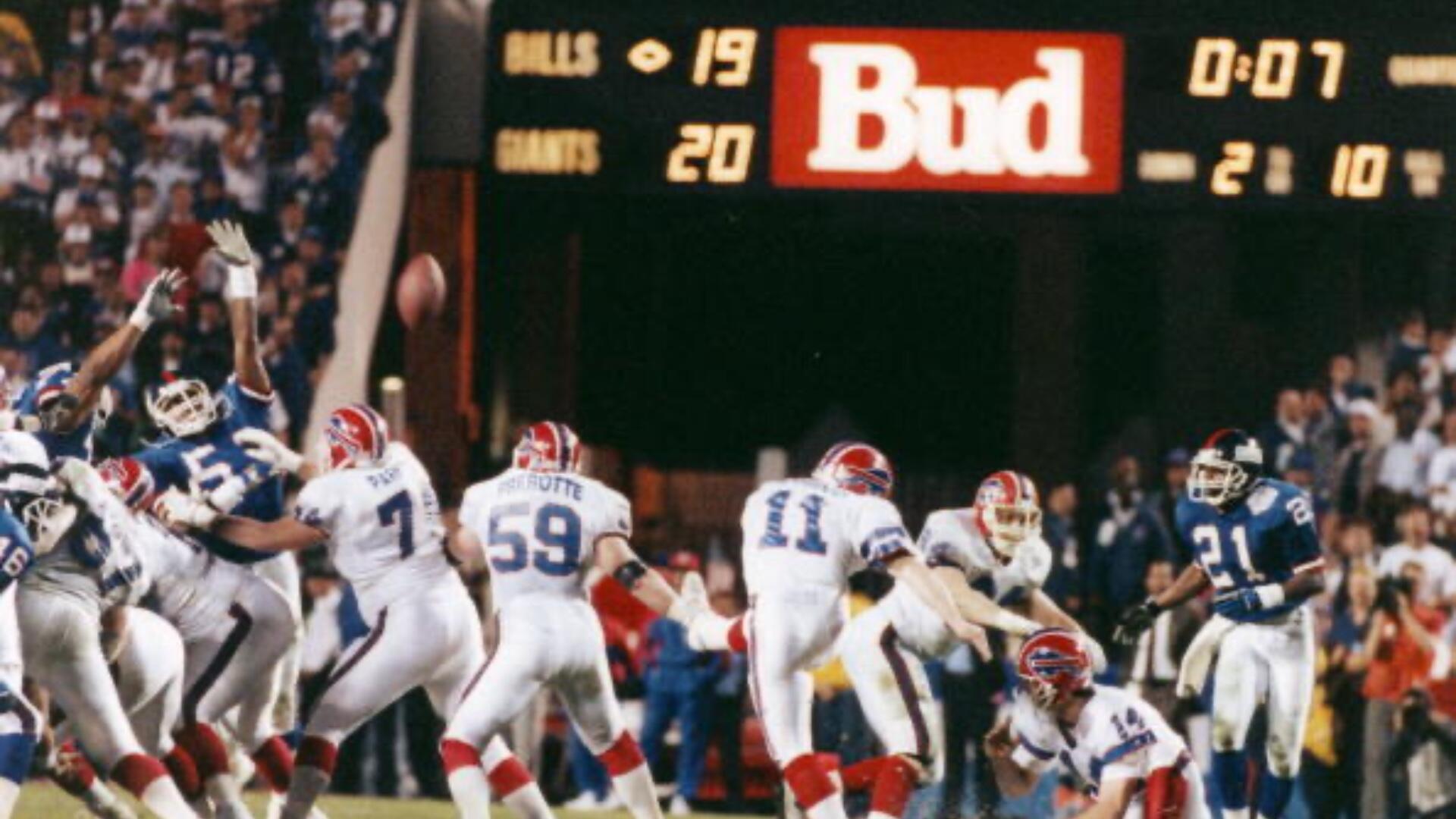
1. Super Bowl XXV (1991): Giants 20, Bills 19 Played in the backdrop of the Gulf War, the game started with Whitney Houston’s emotional rendition of the national anthem. Houston’s performance set the stage for the greatest Super Bowl ever played, a game so good that Ray Romano recorded it over his wedding video.Atmosphere aside, there are tangible reasons why this game is No. 1. It was close and competitive from start to finish. It was a clean game (no turnovers) that had just enough points to satisfy fans of both offense and defense.Adding to the mystique of this game were the dynamics at hand. Facing the Bills’ high-scoring offense, and with his own offense featuring backups in quarterback Jeff Hostetler and 34-year-old running back Ottis Anderson, Giants coach Bill Parcells knew that he needed the right game plan in order to pull off the upset. Parcells employed a ball control offense that maintained possession for a 40 minutes and 33 seconds, a Super Bowl record. The Giants ended the first half with an 87-yard drive and started the second half with a 75-yard drive. Both drives included powerful runs by Anderson (who would win MVP after rushing for 102 yards and a touchdown) and clutch third down conversions by Hostetler, none bigger than his third-and-13 conversion to Mark Ingram that helped give the Giants a 17-12 lead late in the third quarter. Defensively, the Giants were instructed by coordinator Bill Belichick to concede the running game while not allowing the Bills’ explosive passing game to beat them. While Thurman Thomas ran for 135 yards, Buffalo’s “K-Gun” passing attack was held in check during the final three quarters.Despite the Giants’ masterful game plan, the Bills took a fourth quarter lead after Thomas scored from 31 yards out on the first play of the fourth quarter. Undaunted, the Giants countered with another lengthy scoring drive that gave them the lead while setting the stage for one of the most dramatic finishes in Super Bowl history.Down by a point, the Bills took over at their own 10 with 2:16 left to play. With New York employing a slew of defensive backs, Buffalo relied on runs by Thomas (who finished with 135 yards on just 15 carries) and Kelly to advance to its 45-yard line with 1:02 left. For a second, it appeared that Thomas was on his way to the game-winning score, but Giants defensive back Emerson Walls made a clutch tackle that prevented Thomas from possibly going the distance.A short completion and an 11-yard run by Thomas put Scott Norwood in position to attempt a game-winning, 47-yard kick with eight seconds left. Norwood had never made a kick from that distance on natural grass, and that remained the case after he pushed his kick wide right and sent the Giants’ bench into euphoria.The Giants’ 20-19 win (the smallest margin of victory in Super Bowl history) had long-term ramifications. The Bills lost each of the next three Super Bowls and remain in pursuit of their first Vince Lombardi Trophy. The win all but sealed Parcells’ future place in the Pro Football Hall of Fame, where Belichick’s defensive game plan for this game also resides.Norwood’s miss was a climatic ending to the greatest Super Bowl ever.
Getty Images
已发布: 2026-02-04 13:11:00