How are students reshaping the politics in Bangladesh?
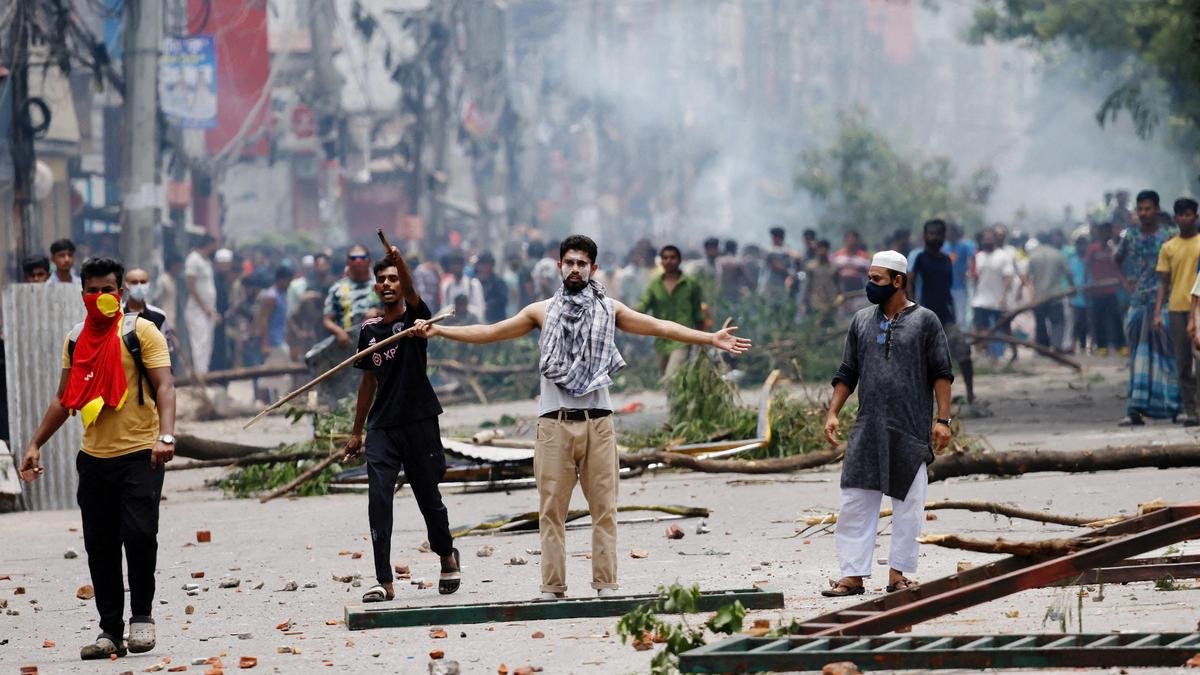
On August 5, 2024, the Sheikh Hasina government, which had ruled Bangladesh with an iron fist for nearly sixteen years, collapsed following the quota reform movement led by students and political parties. Over the course of the July-August uprising, a few incidents stand out.First, is the role of the private universities, which had largely stayed away from political movements till then. Second, is the part played by the ‘study circles’, formed three years before the collapse of the government to escape government surveillance. Third, is the prominence of the Jamaat-e-Islami (JeI) and its student cadres. Fourth is the disappearance of the Bangladesh Chhatra League — the student wing of Sheikh Hasina’s Awami League (AL) — a day prior to the students’ march to Dhaka.Historically, students have been at the forefront of various political movements in Bangladesh. Be it the language movement that saw the students of the Dhaka University (DU) demand the recognition of Bangla as the national language, or the students handing over the flag of the independent Bangladesh to Sheikh Mujibur Rahman prior to the Liberation War of 1971, or the anti-Ershad movement of the 1990s, or the latest July revolution of 2024, students have played an important role in shaping the politics of the country.More than students’ causesA remarkable factor of these protests has been the students’ capacity to transform their causes into broad-based movements. In the 2024 July -August uprising that ultimately overthrew Ms. Hasina, not only the teachers, but the parents of the students too became part of the movement. “It was impossible to keep the children at home. As they moved to the streets, the parents joined them,” a witness said. What began as a students’ movement effectively became a Chhatro-Janata (student-people) movement eventually.The 2024 protests also saw political actors and cadres play a significant role, organising and implementing the agenda of the students. This was evident from the fact that the students, who wanted a reversal of the quota system, were unwilling to renounce their protests even after the Supreme Court scrapped the High Court decision. It is likely that the Opposition political parties, which had a vested interest in removing Ms. Hasina, took the centrestage, effectively transforming the objectives of the original movement that focused on quota reforms.Also, Ms. Hasina’s government, that had conducted three flawed elections, lost touch with the ground. The dissatisfaction and discontent among the people were apparent as corruption had seeped into the system. Ruthless repression was unleashed by a politicised law-and-order machinery that saw its interests entrenched with the survival of the government.The Hasina government’s labelling of the students as razakars (a name used to refer to those who collaborated with the Pakistan Army in 1971) not only incensed them but also showed the government’s efforts at delegitimising the protesters’ demands. The students, however, turned the slogan to their advantage and made it a ‘counter-hegemonic’ line, managing to hijack the narrative-building from the hands of the government.Affluent students from private universities in Dhaka, who had earlier remained aloof during the quota reform movement, also joined the protests, changing the character of the movement. The protests were, as Bangladeshi academic Navine Murshid described, “organised mobilisations against the repressive state apparatus”.Organising the movementSeveral study circles or Patho chakros were established by the students prior to the July upheaval to discuss the political, ideological and social issues confronting Bangladesh. These small groups included intellectuals with whom students could discuss issues that affected Bangladesh politics and share their thoughts on the way forward. One such group was also linked to author and Awami League critic Farhad Mazhar, whose ideas on revolution, especially his book Gono-Obhyuthan O Gothon: Bangladeshe Gonorajnoitik Dharar Bikash Proshongo, were discussed by the students.The formation of these groups was important given the political context. There had been no avenues for students to conduct their activities, share their thoughts or openly criticise the government, due to the draconian Digital Security Act, and a pervasive culture of fear.Groups such as the Bodhi Chakra, the Bhabo Boithak and the Gurubar Adda etc. came into being as discussion forums for politics. These forums created unity among the students, breaching ideological barriers. As Sohul Ahmed, a Dhaka-based political analyst said, “the Shahbag group and the Shapla Chattor group, who stood at the extreme ends of two ideologies, came together in these study circles by bridging the political distance that existed between them since 2013”. The students, without creating a new organisation, took help from existing ones to put forward their ideas.Magazines such as Rashtro Chinta focused on political issues while Purbo Pakho and Ronoppa were cultural journals.Many artists also joined the protest. Not only did they draw posters but they also sang songs of the protests. Some of the participants included the Samgeet and the Anti-Oppression Artists’ Association, visual artist Debashis Chakraborty, artists Sayan and Mousumi, cartoonists Ahmed Kabir Kishore and Mehedi Haque, rapper Hannan, and the University Teachers Network.As the anti-quota movement mobilised, the students also tried to bring the Gen Z and the middle class into its fold. The turning point proved to be when the private university students and madrassa students, who have generally refrained from joining protests of the students at public universities, joined the ‘Students Against Discrimination’ movement.The students who came together to demonstrate against Ms. Hasina included not just the ones belonging to the student-wings of political actors but also the regular students who were concerned about their jobs due to the quota system. Despite lacking ideological coherence, they stood united against the Awami League and the Chhatra League.Political messaging through graffitiNot just the posters and placards carried by the students, but the walls of Dhaka too were used for political messaging, as the Hasina government controlled the media and shut down the Internet for eleven days. As the government and the Chhatra League’s repression intensified, the students, who had mobilised under the name ‘Students Against Discrimination’ (SAD), gave a call for online and offline graffiti on July 18. Ms. Murshid mentions that the Chika Mara (a form of graffiti made popular during the Language Movement of 1952 and the Liberation War of 1971) wall writings, which were deemed ‘vulgar’, were ‘replaced by endless walls of art’. She describes how this wall art now featured detailed Islamic calligraphy since the fall of Ms. Hasina. “What was called graffiti had become politicised in a different way: co-opted to demonstrate the ideals of a “new Bangladesh” after the “revolution” and repurposed to create a certain narrative. It was less about religious messaging and more of an expression of anger conveyed in a beautiful way.
A rickshaw passes by graffiti depicting a rickshaw carrying a student’s body during a protest at the University of Dhaka area in Dhaka, Bangladesh, September 3, 2024.
| Photo Credit:
Reuters
No one knows why they were erased or who gave the instructions (though such graffitis have always given way to new ones). There was also a debate on what to be retained and erased from the walls. The use of inappropriate language in political sloganeering was removed as some argued that ‘profanities did not belong in areas where children and elderly parents could read them’.Some believed that the use of inappropriate language through ‘spray painted scrawls, and the spikes and messiness of the script’ also reflected the ‘chaos, fear and wrath’ felt by protestors persecuted by the law enforcement agencies. A sanitised version of the graffiti that adorned the walls of Dhaka was later printed and presented as the ‘Art of Triumph’ by Chief Adviser and head of the interim government Professor Muhammad Yunus to a visiting delegation.First martyrThe movement had its first martyr in Abu Sayeed, a student from Rangpur, who symbolised the aspirations of millions looking for a government job. He was shot dead on July 17, 2024. The subsequent killings, which numbered close to 1,000, were mostly the result of police firings, completely transforming the nature of the movement and making it about the removal of Ms. Hasina.The protests were no longer restricted to the quota reforms spearheaded by students but had shifted to the hands of a larger political class. This made it difficult for the government to divide the students and arrest their leaders. Subjecting them to intelligence interrogation did not help either.Ms. Hasina had surrounded herself with sycophants and opportunist leaders who could not speak the truth to power. The killings of nearly 1,000 students and youth proved to be the impetus needed to sustain the anti-government movements. Both the Bangladesh Nationalist Party (BNP) and the JeI claimed that their cadres were also among the victims. There were others too, such as policemen, AL workers and minorities who were deemed supporters of the AL. These killings were justified as a reappraisal attack by the administration.Some of the student leaders who were part of the Awami League’s youth wing, the Chhatra League, came out of their cover and identified themselves as part of the Bangladesh Islami Chhatra Shibir — the student-wing of the JeI. In fact, Sarjis Alam, convener of the newly formed student-led National Citizens Party (NCP), who at one point of time had belonged to the Chhatra League, lauded the role of the Chhatra Shibir. This well-conceived policy to use the Awami League and the student organisations as a cover was part of the JeI’s strategy to counter the government repression — something it did in 1972 when the party was banned.For the past 15 years, the Liberation War and the Awami Leagu’s role in it were capitalised by Sheikh Hasina. According to this narrative, Sheikh Mujibur Rahman was the sole proprietor of the Liberation War, and the version perpetuated by Ms. Hasina and the Awami League about the Liberation War became the national narrative. Anyone who questioned this was termed anti-liberation force or razakars.Aftermath of the uprisingThe fall of Ms. Hasina’s government on August 5, 2024, witnessed not just violence against minorities perpetuated by those opposed to the Awami League but also a rush to occupy university halls and ferry ghats to ensure a show of strength. In Bangladesh politics, university halls play an important part in the recruitment of party cadres while occupation of ferry ghats ensures political control and extortion of money from ferry operators, which is a significant source of revenue.This reflected how the more things changed, the more they remained the same. Effectively, the control of halls and ferry ghats had merely shifted from the hands of the Chhatra League to the Chatra Dal — the student-wing of the BNP.The student-led NCP, which had projected itself as the main stakeholder of the July revolution, demanded a trial of Awami League workers and other high officials involved in the violence of July 2024. It accused the chief of the Army Staff, General Waker-Uz-Zaman, of forcing its members to accept a ‘refined Awami League’ when party leaders and Students Against Discrimination activists Sarjis Alam and Hasnat Abdullah, went to meet him.The Army subsequently denied this allegation, with student leaders such as Abdul Hannan Masud, senior joint chief coordinator of the NCP, opposed to expressing such views against the Army in public.Meanwhile, the press wing of the Bangladesh Armed Forces, the Inter Service Public Relations (ISPR), while acknowledging that the Army provided shelter to politicians, judges and police, also said “After the fall of the previous government during the students-and-citizens-led uprising, the overall law and order situation in the country deteriorated significantly due to the activities of certain conspiratorial elements.”This breakdown in security led to attacks on government offices and police stations, violence against political activists and supporters of the Awami League, arson, mob justice, thefts, and looting. In such a chaotic and volatile environment, many citizens feared for their lives. However, the ISPR later clarified that all these officials left once the situation returned to normal. The NCP has been suspicious of the Army’s links to the Awami League, leading to apprehensions that it may try to rehabilitate the party.Separately, the lifestyles of some student leaders came under scrutiny, as did their sources of wealth. The misuse of official positions by student leaders also made the headlines. An instance to be cited is the opening of an office by the NCP in Dhaka’s Bangla Motor area and the hosting of an Iftar party at a five-star hotel, raising questions about its source of funding. Mr. Alam’s motorcade, comprising over a hundred vehicles, in his hometown of Panchagarh, also raised questions regarding the expenses of this lavish show.The NCP has recently suspended Joint Member Secretary Gazi Salauddin Tanvir on corruption charges. Its Joint Convener Sarwar Tushar was also suspended on moral turpitude as the party tries to build a clean image.After removing Ms. Hasina’s appointees from educational institutions and bureaucracy, the government filled them with the affiliates of the BNP and the JeI.Demolition of 32 Dhanmondi (the former residence of Sheikh Mujibur Rahman), and attacks against former Ministers and their supporters’ houses across the country set the tone for a “new Bangladesh”, where mob violence became the order of the day. In response, the Yunus government launched ‘Operation Devil Hunt’ on February 8, 2025, to address the lawlessness, especially after students and civilians were allegedly attacked by ‘Awami League miscreants’ in Gazipur a day before. Yet, at the same time, mob violence has been justified as ‘expression of anger’.
This aerial photo shows anti-government protestors set fire at ‘Bangabandhu memorial museum’ Dhanmondi locality in Dhaka on August 5, 2024. Protests in Bangladesh that began as student-led demonstrations against government hiring rules in July culminated on August 5, in the prime minister fleeing and the military announcing it would form an interim government.
| Photo Credit:
AFP
The post-uprising period also witnessed a systematic dismantling of anything associated with the Liberation War. Sheikh Mujibur Rahman’s statue was taken down, and his house was set on fire with some even dancing in front of it, which at one point in time, was a political symbol. The house was dismantled when a call for a ‘bulldozer march’ was made on social media with the government quietly presiding over the process.Some even demanded the dropping of the national anthem to do away with Bangladesh’s historical legacy. The final erasure of the Liberation War came when the Awami League was banned following demands by the NCP. Not surprisingly, the Hefazat-e-Islam, an Islamist party, had also joined hands with the NCP to call for this demand.Meanwhile, several protests have broken out against the Yunus government since it came to power on August 8, 2024. While garment workers demanded an increase in wages, secretariat employees went on strike in May 2025 after Mr. Yunus announced a law that enabled the dismissal of public servants for misconduct before due process, which was perceived as an arbitrary move. More recently, schoolteachers protested seeking a salary hike. Separately, there have been frequent protests by political parties too.Post ‘revolution’: new politics?The student leaders who would go on to become part of the newly formed government played an influential role initially. While political reforms were their stated objective, within a few months, it became apparent that the students wanted to form their own party.The Awami League government was massively corrupt and ruthless; but anyone familiar with the functioning of political parties in Bangladesh would be aware that the party leadership reigns supreme and hence the Awami League alone cannot be blamed for Ms. Hasina’s misgovernance. It is also likely that the banning of the Awami League would open up space for both the NCP and the Islamists while the BNP remains a strong contender for power.
Protesters surround a suspected sympathiser of ousted ex-premier Sheikh Hasina, near the house of her father Sheikh Mujibur Rahman, ‘Bangabandhu’ the first president of independent Bangladesh, in Dhaka on August 15, 2024, to mark the anniversary of his assassination.
| Photo Credit:
AFP
The JeI, which has justified its role in the Liberation War of 1971, wants to create a new narrative. The party’s Ameer, Dr. Shafiqur Rahman, said soon after the July-August uprising that Bangladesh has given birth to brave children and has achieved a second liberation. This second liberation would be preserved with blood.The Khaleda Zia-led BNP, which had earlier not supported the ban on the Awami League, interestingly warmed up to the idea. It also accused the NCP of being the ‘Kings’ Party’ and claimed it received patronage from the interim government. It alleged that the NCP was setting up the Yunus government’s agenda along with the Islamists; a point exemplified by the fact that the NCP was joined by the Hefazat, the JeI and its student front, the Chhatra Shibir, and the Amar Bangladesh Party, in its demand seeking a ban on the Awami League.Division within the studentsFollowing its launch on February 28, 2025, the NCP included in its fold students from various political factions who played a crucial role during the student movement. For example, NCP chief coordinator Nasiruddin Patwari had previously served as the assistant secretary for information and research affairs of the Amar Bangladesh Party (AB Party), which had broken away from the JeI earlier. NCP Member Secretary Akhtar Hossain was the convener of the Ganatantrik Chhatra Shakti and a former social welfare secretary of DUCSU.While the Chhatra Shibir played an important role, the party was not included in the NCP due to differences in opinion regarding its role within the NCP. Former Shibir activists on the platform wanted Ali Ahsan Zonaed, former president of the Shibir’s Dhaka University unit and member of the Nagorik Committee’s executive body, as the second-in-command of the new party.The Shibir’s demand for an important position in the NCP was based on its role in the protests. Abdul Shadik Kayem, who belonged to the DU unit of the Chhatra Shibir, said the Shibir worked with various student factions. He said, “I was also in touch with S.M. Farhad (Chhatra Shibir’s Dhaka University secretary) and MahfuzAlam (present adviser in the interim regime). They, in turn, were talking to Nahid Islam and Asif Mahmud. It was on July 3, 2024, that the Executive Council of the Chhatra Shibir met, and a decision was made for the party to support the movement. Without the Shibir’s support, organising the protests would have been difficult.”After Ms. Hasina’s ouster, student-wings of the JeI and the BNP were at loggerheads. Both the Chhatra Shibir and the Bangladesh Jatiotabadi Chatrodal (the BNP’s student-wing) wanted to dominate the campus, creating a problem for the student leaders who had organised the protests under the banner of the ‘Students Against Discrimination’.It was only in October 2024 that the Chhatra Shibir decided to participate in politics actively as they formed a committee in Dhaka University. Earlier on August 13, 2024, the Chhatra Shibir participated in a meeting of 35 other student organisations. The Shibir Public Relations officer had said, “Everyone on campus knew those who were on the committee in 2014 and 2018. The Shibir could not officially announce the committee during Sheikh Hasina’s regime”. In 1990, an organisation named Paribesh Parishad, representing all active student organisations of the Dhaka University, had passed a resolution to not allow the Chhatra Shibir from carrying out political activities at the varsity. Despite such stipulations, the Shibir remained active.
Anti-government protestors display Bangladesh’s national flag as they storm Prime Minister Sheikh Hasina’s palace in Dhaka on August 5, 2024.
| Photo Credit:
AFP
Another group that was excluded from the NCP were leaders from private universities, who played a significant role in the student movement. While announcing its 50-member advisory Council on August 14, 2025, the party did not include any students from private universities.There was also a debate on whether the NCP should include in the council former Shibir cadres whose parent party, the JeI, was opposed to the Bangladesh Liberation War. The Shibir’s role in the student movement was recognised by Sarjis Alam of the NCP. Speaking at a Chhatra Shibir rally at the Suhrawardy Udyan in December 2024, Mr. Alam said, “We found Islami Chhatra Shibir to be our allies in 2024. They supported us both directly and indirectly by being present on the streets, offering advice, and playing the role of allies at crucial stages.”Former Shibir activists who were part of the Students Against Discrimination movement, later formed an NCP Committee and pressed for the inclusion of Ali Ahsan Zonaed and Rafe Salman Rifat, former presidents of the Shibir’s Dhaka University unit. But this was not accepted. These members then decided to form the United Peoples Bangladesh as a new political organisation including the members who participated in the July revolution.Reforms is one of the areas where there has been no consensus among different stakeholders. After enforcing a ban on the Awami League, the students want to do away with the 1972 Constitution which they have termed as a ‘Mujibbadi Constitution’. They insist on a referendum on the July Charter and a new Constitution. The NCP has called for the implementation of reforms before the election. Nahid Islam, convener of the NCP, have of late become critical of the advisers and have said that most of them are aligned with political parties and are looking for a safe exit once the election is over. It appears that Bangladesh politics has come a full circle as anti-terrorism law is used for arbitrary arrests to silence dissent, and mob violence is condoned as ‘acts by pressure groups’ and ‘outburst of public anger’. Interestingly, the NCP, along with four left political parties have refused to sign the ‘July Charter’ that recommends state reforms, while Mr. Yunus described the Charter as a harbinger of ‘New Bangladesh’. Meanwhile, 24 other political parties have signed the Charter. While the students played a significant role in the uprising, it may not be easy to turn their success into political capital and win elections. Nevertheless, the student uprising will remain an important historic milestone in Bangladesh’s political journey.Smruti S. Pattanaik is a Research Fellow (SS) at Manohar Parrikar Institute for Defence Studies and Analyses
已发布: 2025-12-21 07:02:00
来源: www.thehindu.com