What has gone wrong for four teams trying to make the playoffs?
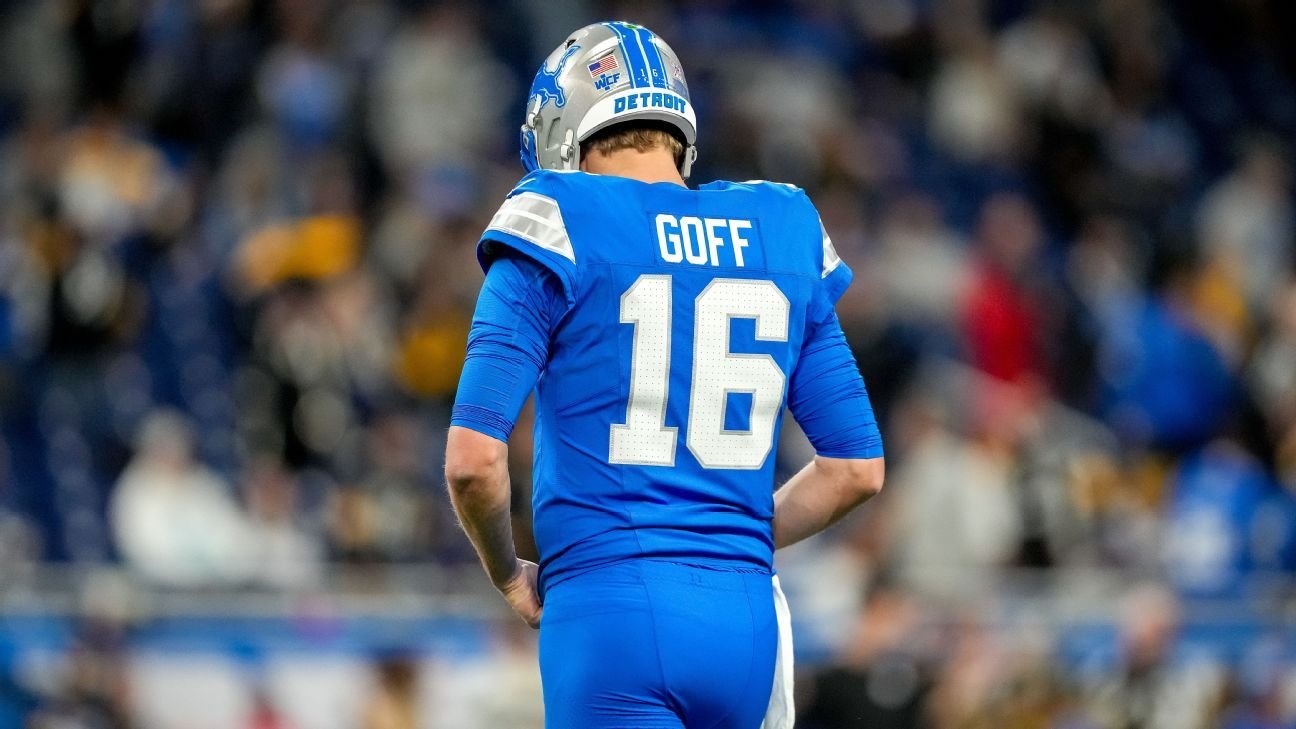
Ben SolakDec 23, 2025, 07:00 AM ETCloseBen Solak joined ESPN in 2024 as a national NFL analyst. He previously covered the NFL at The Ringer, Bleeding Green Nation and The Draft Network.Week 16 of the NFL season is in the books. We entered the slate with two guaranteed playoff teams, and we leave it with 10 — what an eventful weekend! The Jaguars, Chargers and Bills all clinched with the Colts’ loss Monday night, leaving eight teams competing for four spots and others vying for positioning.You know what isn’t vying for a positioning? This column, which comes to you every Tuesday. Though this is the last one, as we reset our content for the playoffs. Thank you to everyone who made my NFL thoughts a part of their coffee, commute or workplace procrastination this season.I’ll be back next Tuesday with my All-Rookie team (ooh! fun!) and every week following with postseason analysis. Stay tuned!Jump to a section:Big Thing: Four teams outside looking inSecond Take: Ben Johnson is COYMailbag: Answering questions from … youNext Ben Stats: Wild Week 16 statsThe Big Thing: What went wrong for four teams trying to get into the playoffs?Every week, this column will kick off with one wide look at a key game, player or trend from the previous slate of NFL action. What does it mean for the rest of the season? This week, we’re looking at the four teams that are still alive for playoff spots but aren’t currently occupying one of the 14 berths. The 2025 playoffs are mostly full. The Panthers, Texans, Packers and Steelers currently hold the remaining open spots, with the Buccaneers, Lions, Colts and Ravens outside the field. All four of those squads still have a shot — but to be on the outside looking in as we approach Week 17 is a sign that your season did not go as planned.For some of this season’s biggest disappointments: my view on what went wrong.As is often the case with would-be contenders, health is the first and greatest culprit. The Lions are second in the league with 267 total games missed for injury, via Sports Info Solutions, and injuries have compounded at key spots. Starting safeties Kerby Joseph and Brian Branch — both Pro Bowlers — are on injured reserve for the rest of the season, while starting cornerbacks Terrion Arnold and D.J. Reed have missed substantial stretches. No. 1 tight end Sam LaPorta is out for the season because of a back injury, and backup Brock Wright is on injured reserve because of a trachea injury. It’s one thing to catch the injury bug, but it’s another thing when it’s siloed in particular positions. That really exposes a team’s depth.At no spot on the roster have the Lions suffered attrition worse than the interior offensive line. Center Frank Ragnow retired and was replaced by Graham Glasgow, who was replaced at left guard by 2024 backup Christian Mahogany. Rookie second-rounder Tate Ratledge stepped in at right guard for Kevin Zeitler, who left in free agency. The Lions were going to be thin on the interior, but it was a risk an increasingly expensive roster would need to take.It has backfired spectacularly. Four players have taken meaningful snaps at left guard this season, as Mahogany and primary backup Kayode Awosika have endured injuries that forced Trystan Colon and Miles Frazier onto the field. On Sunday against the Steelers, the Lions’ third center (Kingsley Eguakun) started the first game of his career, as Glasgow, Colon and Awosika were not available.Poor interior play has been a death knell for the Lions’ offense. Quarterback Jared Goff, for all of his strengths and improvement over the years, remains a heavy-footed pocket manager who doesn’t throw well from adjusted platforms. By quickly compromising Goff’s throwing platform, the Steelers did not need to last for four or more seconds in coverage or successfully tackle running back Jahmyr Gibbs on checkdowns. Goff took three sacks and had several more inaccurate passes, as the Steelers forced him to play without his feet under him.pic.twitter.com/3qjdaLkCQq— Good Clips (@MeshSitWheel) December 23, 2025 The interior offensive line also limited the running game. The Lions ended Sunday with only 15 rushing yards, their fewest in any game since 2016; they had only 12 rushing attempts, their fewest in any game since 2012. Pittsburgh edge rushers Alex Highsmith and Jack Sawyer played extremely aggressively downhill, closing hard on interior runs and beating pullers to the point of attack.pic.twitter.com/5RLiQuxJ8X— Good Clips (@MeshSitWheel) December 23, 2025 When Detroit fails to control unblocked edge rushers, Goff’s lack of mobility and inability to throw on the move can hamper the offense. Over the past six weeks, Goff has 13 dropbacks on designed rollouts (2.2 per game), with only five completions for 22 yards. Ideally, the coordinator of a team with liable interior pass protection can move the launch point for his quarterback — but that button isn’t available for head coach Dan Campbell.Since Campbell took over playcalling, it’s worth noting that the offense has clearly improved. We now have a seven-game sample of Campbell’s playcalling relative to the eight games of coordinator John Morton prior to the switch, and the offense has generally moved the ball more reliably despite the Lions’ record in Morton games (5-3) being superior to Campbell games (3-4).Weeks 1-9Weeks 10-16Offensive playcallerJohn MortonDan CampbellYards per play5.86.5EPA per play0.090.13Success rate43.7%43.8%Points per drive2.582.8Series conversion rate73.3%76.0%This is where the defensive issues take over. With a healthy defensive backfield, the Lions’ defense was as envisioned for the first half of the season. The Lions could play man coverage and challenge at the line, flopping from single high to split field with their two talented safeties. First-year defensive coordinator Kelvin Sheppard could dial up the blitz or lean off it against elite quarterbacks. They had real teeth: 1.93 points per drive allowed, 59% success rate and 0.02 EPA per play — top-10 numbers across the board.The Lions have cratered in the back half of the season, though. They’ve fallen from eighth in EPA per play to 28th and ninth in points per drive to 28th. Big plays are ripping through the depleted secondary at a 17.5% clip, second only to the Bengals for the highest rate in the NFL.This is, of course, doubly frustrating because it’s also the story of last season. Detroit had some defensive success early but limped into the postseason without Alim McNeill, Aidan Hutchinson, Marcus Davenport, Derrick Barnes, Carlton Davis III and Amik Robertson. Their divisional-round exit against the Commanders was swift and merciless.Because injuries have played a key part in both the offensive and defensive stories in Detroit, it’s tempting to wave away the entire season with gauze and bandages. But we should resist that temptation. That the Lions’ depth was tested was a predictable and even inescapable reality of transitioning from the plucky upstart riddled with rookie contracts to an established contender with expensive veteran deals. The margins were always going to get thinner.This season serves as a reminder of two key tenets of team building that the Lions must obey moving forward. The first is the importance of the interior pass protection for a quarterback such as Goff. Quicker and more explosive QBs can account for interior pressure, but Goff simply doesn’t have the juice. It’s easy to say now, but the Lions should have been more willing to miss out on the David Montgomery extension (or even, dare I say, the Taylor Decker extension, as his quality of play has diminished) to create more certainty along the interior. Ideally both left guard and center — or at least one of those spots — should get new starters in 2026, and that’s while projecting some improvement from Ratledge at right guard.play0:43How the Lions fumbled their playoff chancesEric Woodyard reports on the mistakes that cost the Lions against the Steelers.Offensively, the Lions’ playcalling is not an issue, but it’s also not ideal. They experienced the expected dropoff of going from a truly elite playcaller (Ben Johnson) to an inexperienced one (Morton), and Campbell had to scramble midseason to stem the bleeding. I imagine Campbell will hire a new offensive playcaller this offseason and demote Morton to senior offensive assistant (what he was in 2022).The larger tenet, however, is one Campbell has already spoken of but that we too easily forgot on the outside: It’s hard to get back. Campbell famously told his team in the losing locker room of the NFC Championship Game at the end of the 2023 season that “they may not be back here again.” It was a begrudging acknowledgment that success isn’t repeatable in the NFL. In the hypercompetitive modern NFL, even Mount Rushmore quarterback Patrick Mahomes and historic head coach Andy Reid find themselves on the outside of the playoff picture looking in — because they didn’t innovate. They lost the cutting edge.Detroit staved off its coordinator losses for years. Johnson and former defensive coordinator Aaron Glenn started interviewing for jobs after the 2022 season and didn’t take one until after the 2024 season. The bill came due this season on the window that Campbell was somehow able to wrench open for multiple seasons. In not just Sheppard, the Lions’ green defensive coordinator, but also in running backs coach Tashard Choice and linebackers coach Shaun Dion Hamilton, Campbell has gambled on young coaches and invested in their growth.In 2021 and 2022, the Lions had time to develop their youth under the cover of no expectations. All of their mistakes and losses are in the sunlight now. Campbell is known as an elite developer, which alone is reason to buy stock in the 2026 Lions. But expectations force urgency and foster impatience. Once again, the margins are thinner.Here’s a graph of Baker Mayfield’s success rate in all of his career games. It’s a 10-game rolling average, with his different games for different teams highlighted.pic.twitter.com/dZGhj0KzzD— Good Clips (@MeshSitWheel) December 23, 2025 What is eerie to me about this graph is how much the Buccaneers’ arc looks like the Browns’ arc. After a little bit of rookie noise to start his career, Mayfield had a solid trajectory in Cleveland before getting banged up and seeing his play tail off. He was traded to Carolina, got released by the Panthers, did his stint in Los Angeles with the Rams then signed a small deal with Tampa Bay. We all know the story from there.A prevailing and reasonable theory for Mayfield’s deterioration in play this season is that he is playing through injury again. He suffered a sprain to his non-throwing shoulder against the Rams last month. But even before that, there was a weird three-week stretch in which he didn’t scramble at all, and it feels like his accuracy has been scattershot all season.But Mayfield’s off-target rate this season is 16.8%, right around his career average (16.2%). The outlier season was actually last year when he had an 11.8% off-target rate — easily the best of his career. His completion rate this season (61.6%) is right below his career average (63.3%), while last season’s 71.4% rate was the best of his career by more than 7 percentage points.I still think it’s true that Mayfield is playing at less than 100 percent. But we so quickly change our opinion on quarterbacks year over year that an astonishing season like Mayfield’s 2024 campaign quickly throws our perspective out of whack. This season isn’t the surprising or inexplicable season. Last season was. It was the presence of a largely healthy offensive line and an elite schemer in Liam Coen that inflated Mayfield’s play beyond what should reasonably be expected of him. (Don’t worry, Jags fans. Trevor Lawrence is different.)We can call this season a return to Earth for Mayfield while still acknowledging the extenuating circumstances. First-time offensive coordinator Josh Grizzard is still finding himself and what he believes on offense, as the Bucs’ approach has vacillated between various identities to account for different players’ availability. The absence of Bucky Irving has dramatically affected the Bucs’ running game (0.05 EPA per rush with him vs. minus-0.04 without him this season) and their screen game (0.21 EPA per dropback last season, 0.02 EPA this season). The absence of wide receiver Mike Evans has dramatically affected their red zone touchdown rate (66.7% with Evans as compared with 54.5% without him). And of course, the lack of Coen affects all of this.But still, Mayfield has not been good. He is back to highly erratic pocket play now that the Buccaneers’ offensive line is less than elite. (Two backup guards will likely play the rest of the season.) His escapability is not nearly as good as he thinks it is, which leads to unnecessary sacks for large losses. And because he plays with such frenetic feet, he’s liable to badly spray makeable passes.pic.twitter.com/82gMXznY8w— Good Clips (@MeshSitWheel) December 23, 2025 Mayfield is still a solid starting quarterback, and his contract extension is very reasonable. He has been a problem for the Buccaneers this season — but not their biggest one.Coach Todd Bowles has struggled to figure out the Buccaneers’ defense for an unacceptably long period of time. While there have been reasons for poor play in various pockets over the past few seasons, a good defensive coach should eventually get a stretch of good defensive play. Over the past three seasons, the Buccaneers are 22nd in defensive success rate and 22nd in defensive EPA per play. Eight of the 10 teams below them have seen at least a defensive coordinator switch, if not a head coaching change, in that time period.Bowles’ team philosophy is clearly reflected in how his defense has performed over this large sample. The Bucs are 26th in EPA per dropback faced but fifth in EPA per rush faced; they are 25th and fourth in the same pass/run split by success rate. Independent of player injury/matchup and team offensive performance, stopping the run at all costs has left the Buccaneers’ pass defense liable.Without an above-average defense over the past three seasons, it’s difficult to figure out what Bowles is adding to the Buccaneers. By his own acknowledgment, the team had lost intensity and focus, and the Bucs needed to look in the mirror before the Panthers game in Week 16. They did yet lost that game. The Bucs are 30th in fourth-down decision EPA, ahead of only the Jets and the Titans. Bowles had an enormous hand in the Buccaneers’ run-heavy offensive approach this week, and he probably has had that influence for a while. In five of the Bucs’ past eight games, they’ve had run rates 10 percentage points over expectation, per NFL Next Gen Stats. Directionally and in execution, Bowles is not carrying the water a modern NFL coach needs to carry.Tampa Bay has endured a gamut of injuries, especially on offense, and remains in striking distance of the NFC South crown so long as it wins its Week 17 game against the Dolphins (and Quinn Ewers). Then it’s win and in versus the Panthers, a team the Bucs very well could have — and should have — beaten on the last drive this past week. Things are far from disastrous.But disaster can be good, if it forces necessary philosophic or staff changes.What is there to say about the Colts? They were 8-2. Then, they lost five in a row. They were definitely good — on a historic pace offensively. But quarterback Daniel Jones fractured his fibula in practice, and then popped his Achilles in a game. Philip Rivers then came out of retirement. And now the Colts are a feel-good story because they’re getting close to winning, but not actually competing — like a young team with a third-round rookie quarterback showing some pluck. From deeply serious to deeply unserious in one month.Of course, there are layers. The cracks in the facade started to show long before Jones got hurt. As I wrote in Week 9, Jones’ play under pressure had gone from historic QB1 numbers to league worst in a two-game stretch. An absurdly small sample … but maybe a portend of things to come?The Colts sure thought it was. I still don’t understand the impetus, but after seven weeks with a pressure-to-sack rate of 7.1% (tippy-top elite number), Jones had three straight weeks with a pressure-to-sack rate of at least 27.8%. He quadrupled how often he took sacks.Editor’s Picks2 RelatedShane Steichen reasonably began bailing water out of the leaky boat, scuttling the Colts’ empty-protection passing concepts and keeping way more players in the protection scheme. It helped, as Jones’ sack rate fell way down, but his time to throw, as well as his accuracy, also fell precipitously. After a Week 11 bye, he posted a completion percentage 10.9% below expectation in Week 12 (worst of his season, per NFL Next Gen Stats) and then 7.9% below expectation in Week 13 (second worst of his season). In Week 14, he tore his Achilles.As is often the case with average quarterbacks propped up by elite offensive environments, when things fall apart, they fall apart fast. The middle of Jones’ season felt eerily similar to the end of Sam Darnold’s season in 2024, when defenses found a button they could press to disrupt his game, and the house of cards crumbled around him. It’s also reminiscent of Darnold’s 2025 season — Darnold’s play has fallen off precipitously since his Week 11 game against the Rams, and even in his Week 16 revenge victory, he averaged minus-0.40 EPA per dropback.An awkward reality of NFL player performance is that we want our average players — the 19th-best quarterback, 14th-best offensive tackle and 17th-best kicker — to have average games. But they don’t. They have spectacular games and then terrible ones. They are average in the aggregate, but their individual performances are volatile, and in the case of some players, highly volatile. When Jones was at his peak with the Colts’ offense, there was an inevitable regression to the mean on the horizon. The only question would be the steepness of the fall.We can’t really answer that question, as he got hurt before we saw his and Steichen’s final efforts to escape the tailspin. And unlike Darnold, who is supported through his ups and downs by a truly terrorizing defense, the Colts’ lone engine was their offense.This is really what you have to shrug your shoulders at. The Colts understandably pushed their chips to the middle with the Sauce Gardner trade and got handed about the worst possible runout. CB2 Charvarius Ward suffered his third concussion of the season, leaving the Colts with coverage liabilities even when Gardner was healthy; Gardner strained his calf and hasn’t played in three games; star defensive tackle DeForest Buckner returned from a Week 9 neck injury in Monday’s loss to the 49ers. Too little, too late.The theory behind the Gardner trade was sound. He’s a field-altering player who would unlock their defense’s ability to play man coverage and create turnovers in zone coverage. When Jones’ struggles occurred, the defense was expected to do its part to mitigate the damage. But Gardner got hurt, Jones got hurt, and the other star defensive players who could have been difference-makers during this five-game losing streak got hurt, too. That’s just how the cookie crumbles sometimes.Of all these teams, the Colts’ in-season lessons are the least interesting. It’s fair to call the Gardner trade reckless, but anyone claiming the Colts’ trade for Gardner was indefensibly aggressive is benefiting far too greatly from hindsight. The AFC playoff field turned out to be wide open, without the Chiefs and likely without the Ravens, too. This was a reasonable swing.play1:11Brock Purdy slings 5 TDs as 49ers rout Colts on MNFBrock Purdy delivers a masterful performance to lead the 49ers to a big win over the Colts.The Colts’ offseason will be the most interesting to observe. How they manage their quarterback contracts will be as fascinating an offseason question as I can remember. Jones is a rising free agent and Anthony Richardson Sr. is approaching the fourth year of his rookie deal before the fifth-year option. The Colts must roster two potential starting quarterbacks for this upcoming offseason, as they did last year. Jones should be one — but on what sort of deal? Can the Colts make anything larger than a one-year commitment to a player who likely won’t be available for Week 1? And do they feel good enough about Richardson as the backup who might need to start four … six … eight games?Beyond the quarterback question, the Colts have only two edge rushers under contract in 2026 and desperately need juice at the position. There is only one linebacker under contract in 2026, and Indianapolis needs coverage ability at that position. The Colts started investing in an impactful defense with the Gardner trade and the signings of Cam Bynum and Ward. Will Colts general manager Chris Ballard be willing to double down, or will he wave the white flag on reconstructing the defense?Great February/March team. As for the rest of the season … let’s just enjoy the Rivers news conferences.The story of what went wrong with the Ravens has some notable similarities to the Lions’ story. While Detroit had a lot of injuries, the Ravens suffered specific, major injuries. Star defensive tackle Nnamdi Madubuike was lost for the season to a neck injury. And star quarterback and two-time MVP Lamar Jackson missed three games because of a hamstring injury and hasn’t been the same player since returning, with his athleticism clearly sapped and rushing ability accordingly hampered.Beyond the Jackson injury, the major issue on offense this season has been the play of the Ravens’ offensive line. Baltimore bet on internal development with 2022 fourth-rounder Daniel Faalele and 2023 seventh-rounder Andrew Vorhees at guard and has gotten below-average return on its investment. Even 2024 second-round right tackle Roger Rosengarten has been only an average starter. The talent drain along the offensive line over the past two seasons — Morgan Moses, John Simpson, Kevin Zeitler, Patrick Mekari — has finally caught up to Baltimore now that Jackson can’t solve problems as easily with his legs.All of ESPN. All in one place.Watch your favorite events in the newly enhanced ESPN App. Learn more about what plan is right for you. Sign Up Now
But beyond the line, it’s important to have an honest conversation about the Ravens’ supporting cast of skill players. It is not very good. As I wrote a few weeks ago when assessing panic levels of teams on the bubble, there isn’t a feared pass catcher on the Ravens’ offense. You don’t have to game plan for Zay Flowers, even if he is productive on screens and deep-breaking routes. He’s not a tackle breaker and doesn’t make spectacular catches. And as we’ve regularly seen in end-of-game situations, he makes critical mistakes — drops, failed first downs with bad decisions and, of course, fumbles. That’s how the Ravens’ comeback hopes ended against the Patriots on Sunday night.The Ravens’ commitment to philosophy of draft, develop and extend is admirable and has generally served them well. But even the best drafting teams go through lulls, and without free agency to buttress the roster, the talent pipeline can dry up quickly. The only Ravens who were acquired via traditional free agency are running back Derrick Henry, receiver DeAndre Hopkins, offensive tackle Joseph Noteboom, quarterback Cooper Rush, defensive end Brent Urban, defensive tackle John Jenkins, cornerback Chidobe Awuzie and linebacker Jake Hummel. Henry is already on a restructured deal after his breakout 2024 season, and his $8.5 million cap hit represents 43% of the total cap the Ravens are spending on outside free agents this season. He’s the only one with a cap hit above $2.01 million.Of course, the Ravens successfully acquire talent from other teams via trade. Linebacker Roquan Smith, safety Alohi Gilman and edge rusher Dre’Mont Jones are recent trade acquisitions that have worked well. And they aren’t without their draft successes. Safety Kyle Hamilton got his deserved massive extension, and center Tyler Linderbaum, a fellow first-rounder, is next in line. But did 30-year-old tight end Mark Andrews need a new deal in his worst season as a receiver by per-route production? Did the Ravens need to beat the wide receiver market so aggressively this offseason in extending Rashod Bateman before his worst season in per-route production?Remember, this was an issue before Henry originally signed in the 2024 offseason. The 2023 Ravens were the AFC’s No. 1 seed and made it to the conference championship game but lost to the Chiefs in large part because they couldn’t hand the ball off. A rotating backfield cast of Gus Edwards, Justice Hill and Keaton Mitchell had some utility, but it lacked a truly dangerous player. The same concern now stares down the Ravens’ receivers and tight ends, as they might lose Isaiah Likely in free agency while the Flowers/Bateman/Andrews core is two years older. Yes, they’re all handy players who deserve spots on NFL rosters. But they aren’t playoff-caliber, field-tipping, game-altering, math-changing players.Of all the Ravens’ draft misses, they’ve been hurt the most at pass rusher. Baltimore has spent a significant pick on an edge rusher in five consecutive drafts: Mike Green (2025 second-round pick), Adisa Isaac (2024 third-rounder), Tavius Robinson (2023 fourth-rounder), David Ojabo (2022 second-rounder) and Odafe Oweh (2021 first-rounder).NFL Playoff MachineSimulate your own scenarios and check the latest playoff picture. Playoff Machine »• Playoff picture » | Standings » | More »
Robinson, along with Jones, has ousted Green from a primary spot in the starting lineup, though Green gets some run. Ojabo is exclusively depth, and Isaac is out because of an elbow injury sustained in the preseason. Oweh was just traded to the Chargers in the Gilman trade and has a 16% pressure rate and 3.9% sack rate on 181 pass rushes in Los Angeles — better numbers than any individual season of his Ravens tenure.Oweh was the most successful pass rusher of the bunch. By pressure rate, the next best season belongs to 2024 Ojabo at 8.9%; by sacks, Green’s 2025 is tied for the lead with 3.5. Baltimore has gotten plenty from drafted defensive tackles such as Madubuike and Travis Jones (hey, there’s another extension!), but it has gotten next to nothing from its drafted edge rushers, especially now that Oweh is gone.The Ravens’ defensive system isn’t predicated on a dominant four-man rush, of course. And per usual, their defense has steered through a tumultuous first half of the season to rock steady numbers in the second half. If Madubuike can come back healthy next season, the Ravens have most of their defensive core intact and under contract — they just need an edge rusher (or two, or three).So there’s reason to expect the defense to continue excelling next season and for the offense to immediately elevate when Jackson returns to health. You could see that through the cracks in the first half against the Patriots. The defense got stops against one of the league’s best offenses. Jackson looked spry, and the passing game finally looked explosive again. Henry had one of his best games of the season, posting a 66.7% success rate on the ground and the fastest average speed (13.81 mph) on rushes in a game this season, per NFL Next Gen Stats. Had the Ravens finished the job, it would have been a statement win for a team clawing its way back into postseason relevance.Instead, Jackson went down with another injury. Tyler Huntley stepped in admirably, but with Henry sidelined (rather peculiarly) for a potential game-salting drive, the Ravens surrendered their 11-point lead and added another notch on the battered post of games they should have won but oddly lost. Had Jackson been healthy, it likely would have ended differently.True of the game Sunday night. True of the season, too.Second Take: Ben Johnson is Coach of the YearESPN’s “First Take” is known for, well, providing the first take on things — the instant reactions. Second Take is not a place for instant reactions but rather where I’ll let the dust settle before taking perhaps a bit of a contrarian view.I can very easily build a case that the Bears are fake good.Take Saturday’s win over the Packers. The winning play — a 47-yard javelin from Caleb Williams to DJ Moore — was spectacular. Perhaps the best throw any quarterback has made this season. To get there, we needed the Bears to cover a 10-point fourth-quarter deficit — one that had been largely built and maintained by Packers backup quarterback Malik Willis, as starter Jordan Love left in the second quarter because of a concussion.Catch up on NFL Week 16• Takeaways, questions from each game »• Let’s judge big overreactions »• Highlights » | Scoreboard » | More »
Here’s how the Bears bridged the gap. They converted a third-and-20 thanks to a defensive facemask on a sack of Williams, then had to kick the early field goal (which they failed to get off before the two-minute warning), which was not a gimme considering the wind. Then they recovered an onside kick, which historically happens about 5% of the time. They scored a fourth-and-goal touchdown by throwing to a receiver who hadn’t caught a pass in the NFL before this game. Finally, they got a fourth-down stop in overtime on a botched Green Bay snap and then hit their winning touchdown.There were some high-quality plays I skipped over, of course. But you don’t win a game in which you once had a 0.5% win probability without getting a little lucky along the way.The Bears have gotten “a little lucky” a lot this season. They beat the Commanders in Week 6 after Jayden Daniels and Jacory Croskey-Merritt fumbled an exchange on third-and-1 with three minutes remaining. They beat the Raiders in Week 4 on a game-ending blocked field goal and the Vikings in Week 11 with a 56-yard kickoff return with 50 seconds left and the Bengals in Week 9 on a sick Colston Loveland catch that wasn’t so lucky … but the Bengals’ poor tackling was. Those plays take skill, but if there’s a lesson to be learned from the 2024 and 2025 Chiefs, it’s that being good at winning close games is awesome … until it very suddenly, and very brutally, isn’t.The Bears have now won six games in which they trailed in the final two minutes, which is the most such wins for any team since the 1970 merger, per ESPN Research. They are 6-4 when they’ve had a win probability of 20% or worse at any point of a game. Teams are not supposed to win 60% of games in which they have a 20% chance to win. That, quite literally, is not how percentages work.This is the argument that the Bears are fake good, that their record overestimates their overall strength. But it’s simultaneously an argument for Ben Johnson to win Coach of the Year.These end-of-game performances have been the product of unbelievable adjustments and execution. Take, again, the final play against the Packers, that deep touchdown to Moore. This was a play that was put in during the week, as Williams told reporters after the game. “I was watching film in (Johnson’s) office and we just kind of went over small details throughout the play, and the next day we came out and discussed it and hit it in practice.”pic.twitter.com/xbPkZ5UaT7— Good Clips (@MeshSitWheel) December 23, 2025 Moore had a similar sentiment in his immediate postgame interview: “We’ve worked on it in practice. I seen the look. Nobody back deep. I just got to run my ass off. You know, catch the ball for Caleb.”It took time for Moore to get downfield — tough to “run your ass off” in the fifth quarter of a short-week game. Loveland is technically first in the progression here, with Moore only live if there’s no safety in center field — or as Moore said, nobody back deep. In order to buy the time for Williams to make this throw, tight end Cole Kmet must block Green Bay linebacker Isaiah McDuffie one-on-one to the top of the screen, and fellow tight end Durham Smythe has to find blitzing linebacker Quay Walker through the C-gap and get enough of him.This was only the third play-action pass the Bears completed Saturday — a surprise, considering their offense was leading the league in play-action rate entering the game. In the first three quarters, the Bears called only four play-action passes: three attempts, one completion, 3 yards. In the fourth quarter and overtime, the Bears had four attempts, two completions and 68 yards.I’m not sure what it is about Johnson and the Bears’ offensive coaching staff, but they find solutions late. This play was a solution to their play-action woes of the week. Green Bay was hassling Williams on his play-action dropbacks and rollouts, so Johnson kept him in the pocket and max protected, catching the Packers’ secondary playing aggressively in anticipation of quick pressure from their rush.This is not an aberration. When filtering out garbage time, the Bears’ offense goes from 5.3 yards per play in the first half to 6.1 in the second half — the fifth-biggest delta in the league. By success rate, it is a leap of 5.7 percentage points (fourth biggest). By EPA per play, it’s a jump of 0.11 expected points (second biggest). “There’s always an answer with this offensive staff,” Smythe said, and he’s right. No offense adjusts better than Johnson’s unit.After adjustment comes execution. Consider the context here. The Bears are on the fringe of field goal range in an overtime situation in which a field goal wins the game. Williams drops back and sees Loveland breaking across the cornerback’s face — remember, the tight end is his first read, and it’s a throwable ball. A completion here sets up a makeable but long field goal in the wind.But that’s not what the Bears practiced. If the coverage is low, they’re throwing the one-on-one. Come hell or high water, come only two play-action completions, come no offensive touchdowns for the first 59 minutes of regulation, this is how the play is executed. “It’s got a lot to do with … Ben being on our ass every time,” Moore said postgame of all the Bears’ unlikely wins. “We don’t want to go into Mondays or any day with a loss to watch the film.”This astonishing Bears season is undeniably the product of Johnson’s rigor. Recall all of the offseason reports and September musings that Williams would struggle to fit in the offense and struggle to play with the timing that Jared Goff did. Recall the training camp reports that the offense couldn’t move the ball because the motions were too complex, the pre-snap operation too onerous.Moore has been one of the most open Bears players in speaking about Johnson’s intensity. “What’s hard about it is that you’ve really got to be in your playbook and know every last detail of that playbook like he (does),” Moore said in August. “If not, you’re going to get either the evil eye or get yelled at to get in the right spot.”But when asked what he liked about the offense, Moore was clear back then: “It’s going to get us where we want to go.” Look at how right he was.play1:55Can Bears make a Super Bowl run this season?The “Get Up” crew debates whether the Bears can make a Super Bowl run after Caleb Williams led the team to an OT win vs. the Packers.The promise of Johnson was as high as any first-time head coaching hire, and he has delivered on those expectations. Chicago is fourth in fourth-down decision EPA — Johnson is making the right decisions — even if they’re 28th in actual fourth-down results. Johnson is nails on timeout management: He took his first against the Packers with 6:30 remaining in the fourth quarter, when it became clear the Bears would need two drives to tie the game. He has onboarded rookies into his complex offense as the season has gone on; Loveland, receiver Luther Burden III, offensive tackle Ozzy Trapilo and running back Kyle Monangai have been more involved and more productive in the second half of the season.Where would Chicago be without Johnson’s radical cultural shift? Could this team have so easily shed the stink of last season’s collapse without a coach so uniquely willing to adjust and grow? Johnson’s turnaround reminds me so much of what Dan Campbell did with the Lions — with one major difference. It’s happening even faster.So let me posit a new argument. The Bears are a second-half team in every sense of the term. Second half of the game, second half of the season. No team has grown more or adjusted better than the Bears. And for as silly as the early-season victories over the Raiders and Commanders were … they happened. They helped put the Bears on the verge of getting a home playoff game (or two). But the closeness of those games is no longer disqualifying for these second-half Bears, who have changed as much as a team can between October and December. Aaron Schatz shared it on social media just this week: The Bears are 16th in DVOA, but in weighted DVOA, which prefers recent games, they’re 10th. The arrow is rocketing up.The Bears have a supremely talented quarterback on his way to breaking into the league’s top 10. They also have an elite head coach. If Sean McVay and Kyle Shanahan are the NFL’s two best head coaches, how is Johnson not in conversation with Mike Macdonald, Sean Payton and DeMeco Ryans for third?Chicago’s roster is far from perfect, and its luck will eventually swing the other way. But if the Bears are bringing a fringe top-10 quarterback and fringe top-three head coach into the playoffs, how do you not fear them?From y’allThe best part of writing this column is hearing from all of you. Hit me on X (@BenjaminSolak) or by email (benjamin.solak@espn.com) anytime — but especially on Monday each week — to ask a question and potentially get it answered here.From Marc: “Since the NFL merger, no quarterback has ever led the league in passing yards, touchdowns, had single digit interceptions, won at least 10 games and not won the MVP award. You have him third in your rankings. Can you please go into some detail as to why you feel Stafford shouldn’t be the first?”For clarity, I tweeted my hypothetical MVP rankings after Week 16, and had Drake Maye at 1, Justin Herbert at 2 and Matthew Stafford at 3. (If that Herbert ranking surprises you, scroll down.)I think MVP qualification and résumé comparison has gotten entirely out of hand. When I try to figure out who I think has been the league MVP of a given season, I have absolutely no interest in historical MVP trends. Just as easily as Marc says no quarterback has led the league in these categories and lost the award, I can say only two quarterbacks have ever lost their division and won the award. Stafford is an exception through one filter and a no-brainer through the other.play2:26Eisen: Stafford’s performance vs. Seahawks puts him atop MVP raceRich Eisen explains why Matthew Stafford belongs atop the MVP race and how he has strengthened his Hall of Fame case this season.This is where the strength-of-schedule thing also drives me nuts. Maye shouldn’t be the MVP because his opponents were bad? Do we not have eyes? I’m watching a quarterback in impeccable command of a complex offense distribute the ball and draw the best out of a cadre of solid but unspectacular receivers behind a below-average offensive line. That’s value. This isn’t the SEC. I don’t give a hoot about cupcakes.Stafford is unquestionably worthy of being the MVP this season. I’m splitting hairs between him, Maye and Herbert, and the hair is how good the rest of the Rams are relative to the casts of the Patriots and Chargers. Of course, we have plenty of ball left. Herbert has two extremely loseable games upcoming; Maye and Stafford … probably don’t.MVP is and should be a subjective award. If we just hand it to the quarterback with the most yardage or touchdowns or passing EPA every year, we’re fools. Just last season we had our first split MVP/first-team All-Pro ballot between Josh Allen and Lamar Jackson. Voters vote, and trust in the wisdom of that informed panel.From Jack: “Should the Giants draft Fernando Mendoza?”Yes.From Hussle Westbrook: “What coach archetype should Baltimore look for if this is finally it for Harbaugh?”I’d go for a Super Bowl-winning CEO type who regularly makes strong fourth-down and game management decisions. Someone with a proven recent track record of success with a mobile quarterback, too — something like five divisional-round appearances in the past eight years.(I am describing John Harbaugh.)From Cody: “What does Dan Campbell going 1-for-3 on his hiring of OCs tell us about even the best of CEO-style head coaches and what effect might that have on future hiring cycles? Outside of hiring any of McVay’s buddies, why is it so hard to predict who will be a good playcaller?”This is the same question as the franchise quarterback question. The first and biggest issue is simple: There are fewer than 32 of these coaches at any given time. The 32nd-best offensive playcaller in football is incredible at his job and yet is still leaps and bounds below the utmost echelon — the rarefied air of the truly elite. You’re always going to get more offensive coordinator hires wrong than you do right simply because you’re picking from the second crop of playcallers (the first crop are already head coaches), and there aren’t that many coaches in the first crop, anyway.Look ahead to the 2026 NFL draft• Early mock drafts: Yates | Miller | Reid• Early rankings: Kiper | Miller | Reid• 30 questions | CFB notes | QB Board• Best by position | Draft order | More
Specifically to the McVay point: There is a survivor bias there. Without question, the Sean McVay/Kyle Shanahan tree is the most prolific for offensive playcallers. But is the success rate really as good as you recall? Liam Coen, Matt LaFleur and Zac Taylor are all hits … but how were the Shane Waldron offenses? How is the Zac Robinson offense doing in Atlanta? How about Mike LaFleur’s stretch with the Jets? Shanahan has spawned Mike McDaniel and Klint Kubiak, but his staff has trickled down into Nathaniel Hackett, Luke Getsy and Bobby Slowik.There is no sure thing in offensive playcalling, just as there’s no sure thing in first-round draft picks, season-over-season stability and pretty much everything else in the NFL. We’re all guessing at everything.Next Ben StatsNFL Next Gen Stats are unique and insightful nuggets of data that are gleaned from tracking chips and massive databases. Next Ben Stats are usually numbers I made up. Both are below.plus-23.9: That’s Justin Herbert’s total dropback EPA generated against the Cowboys on Sunday. It’s the most EPA generated by a QB in a game this season, and the second most of a game in Herbert’s career.Put another way: Of the 34 points the Chargers scored, Herbert was the primary agent of 24 of them.Of course, we should take all games against the Cowboys’ defense with a boulder of salt. But my heavens was Herbert on fire against Dallas. Against pressure: 9-for-11, 108 yards and a touchdown — no sacks, two scrambles. Against the blitz: 12-for-16, 143 yards, 11 first downs, one touchdown and, again, no sacks. He attacked every level of the field, too: 16-for-18 throwing within 10 yards of the line of scrimmage, and 8-for-10 throwing at least 10 yards downfield. Both of his touchdown throws were 20-plus yards downfield. This is the sort of game we thought elite quarterbacks would have forever, before defenses caught up.The Chargers had their bye week in Week 12, having just lost a brutal and embarrassing game to the Jaguars. It was their second game without Joe Alt and first game with trade acquisition Trevor Penning starting at left tackle. It would be the only game Penning played at left tackle for the Chargers this season — that’s how bad the film was. Herbert was pressured on 52.2% of his dropbacks and had 81 total passing yards.Since the bye, Herbert has singlehandedly decided the offense will be immune to the play of its offensive line. In the four post-bye games, Herbert has been pressured on 47% of his dropbacks — the league-leading rate by an enormous margin — yet is ninth in EPA per pressured dropback in the same stretch. He’s eighth in success rate. He’s first — first! — in yards per pass attempt.play1:00Is Justin Herbert a clear-cut fantasy starter?Tristan H. Cockcroft evaluates Justin Herbert as a fantasy quarterback going forward.Herbert’s scramble rate on pressured dropbacks is 19%, as he has a faster eject button in the pocket .While he has been sacked 14 times, his pressure-to-sack rate of 22.2% is just above league average (18.1%). This is all him, too. Greg Roman and the Chargers’ offensive coaching staff have shown no recourse for minimizing the omnipotent pressure, and given how poor their offensive line talent is across the board, there’s not much they could do. The running game isn’t a salve, either. In the same four-week stretch, the Chargers have 4.2 yards per carry and a success rate of 38.3% on designed runs — both below league average.It is not difficult to build a Herbert MVP case. I have no doubt the Chargers’ offense would be remarkably worse if the presumed MVP — Rams QB Matthew Stafford — were swapped into this offense in place of Herbert. Stafford lacks the mobility necessary to make these pockets viable, and while he’d attempt passes as aggressively as Herbert, he’d be enduring a substantial downgrade in wide receiver quality.The Chargers are in striking distance of the AFC West crown, as a win against the Texans in Week 17 would guarantee that their Week 18 contest against the Broncos would be for the title. Of course, the Broncos and Texans have perhaps the two scariest pass rushes in the league. The Texans, in particular, terrorized Herbert in the AFC wild-card round last season, holding him to 14-for-32 passing for 242 yards and four interceptions while sacking him four times. This is a familiar foe for the Chargers’ offense, and one against which they match up terribly.It’s unlikely Herbert can sustain this level of pressured play against this sheer quantity of pressure — the numbers are too steep. It’s more likely that the combined games against the Texans and Broncos break him — he’s already getting hit more than any quarterback in the league. But if he can endure, the Chargers will win the AFC West, and I will be hard pressed to find a more impressive — or valuable — player in football.1: That’s how many times Pat Surtain II was targeted in coverage against the Jaguars out of 43 coverage snapsConversely, out of 42 coverage snaps, Riley Moss was targeted 12 times (eight catches for 92 yards). Safety P.J. Locke was targeted seven times in 42 coverage snaps (four catches for 33 yards and a score). And in 24 coverage snaps, nickel Ja’Quan McMillian was targeted another four times (four catches for 41 yards and a score).To be clear, these aren’t straight man coverage reps. In fact, the Broncos played a lot of zone coverage in an attempt to close intermediate windows and force Jaguars quarterback Trevor Lawrence to hold on to the football, allowing their pass rush to get home.Breaking news from Adam SchefterDownload the ESPN app and enable Adam Schefter’s news alerts to receive push notifications for the latest updates first. Opt in by tapping the alerts bell in the top right corner. For more information, click here.
The issue is that you can still generally avoid Surtain even in zone, because you know where he’ll line up. Surtain followed Brian Thomas Jr. for most of the game, but the Jaguars have become a spread-the-wealth passing attack during their late-season emergence. Parker Washington (six catches, 145 yards), Jakobi Meyers (four catches, 45 yards) and Brenton Strange (five catches, 39 yards) carried the load while Thomas (two catches, 18 yards) ran Surtain out of impact.The Broncos’ secondary is still great overall. McMillian is an above-average nickel; Moss is a solid CB2. But in the postseason, more offenses will be equipped with the necessary pass-catcher depth to relegate Surtain to an actionless island. The Jaguars did it Sunday. What about the Patriots, with their rotating cast of wide receivers? Or the Bills, who don’t even throw to their receivers anyway?1.23: That’s Shedeur Sanders’ EPA per dropback on screen passes this season. It’s the highest number of any season in the Next Gen Stats databaseRaw stats: 11-for-16 for 210 yards, six first downs and a touchdown. Sanders averages 13.1 yards per pass attempt on screens, which is more than double the league average (5.6) over the past decade. Somehow, Sanders has a completion percentage 8.0% under expectation on screens, which is 406th out of 437 quarterbacks in this sample — so there’s even room for improvement! The screen game could be better!But what Browns head coach Kevin Stefanski and offensive coordinator Tommy Rees have done to create yards after catch and explosive opportunities despite having a fifth-round rookie quarterback playing behind an offensive line with bottom-tier tackle play is quite something. Cleveland’s coaching staff is drawing blood from a stone in its passing game right now, and every game in which the offense hangs is a testament to that effort.
已发布: 2025-12-23 12:44:00
来源: www.espn.com