How Two YouTubers Became the Creator Industry’s Secret Weapon
O
n a sleepy morning in Venice Beach, California, Samir Chaudry and Colin Rosenblum are leaning forward excitedly in their chairs. They’re a certified brain trust for some of the internet’s biggest creators, but right now, they can’t stop talking to me about birding.
More specifically, they’re talking about a documentary called Listers, a two-hour deep dive into the world of “extreme birdwatching.” The film was created by brothers Owen and Quentin Reiser and posted to YouTube in August 2025, where it racked up more than 2.6 million views for its quirky blend of amateur documentary and stoner confessional. The long watch feels a bit antithetical to what YouTube has become known for — easily digestible bites of content — but Chaudry calls it “one of the most interesting things” he’s ever seen. That’s partly because of the content — the character introduction, comical odes to Cracker Barrel, and the inviting cinematography — but it’s also because of how the brothers are making money from it. “(Owen) turned off ads because he didn’t want to mess up the experience, and he put his Venmo in the description,” Chaudry explains. “By the time we interviewed him, people had Venmo-ed him $75,000. Insane.”
There is no one way to make money on the internet anymore. Creators are now a billion-dollar industry in the U.S. alone, driving the TV audiences watch, the films that get made, and the voices shaping our culture. But what’s sexy on social media isn’t what necessarily makes millions. Over the past decade, Rosenblum and Chaudry have figured out what it takes to be a full-time creator, and have turned that expertise into a social media empire. On their YouTube channel, Colin and Samir, and podcast, The Colin and Samir Show, they’ve talked to MrBeast about his sprawling Greenville, North Carolina, content complex, Emma Chamberlain on the addictive nature of YouTube, and Casey Neistat about making art that’s not ruled by the algorithm. They only have 1.6 million subscribers on YouTube and less than 200,000 on TikTok — statistics that feel dwarfed by those of the people they interview. But their “about creators, for creators” approach combines personal research with expert advice, giving their online presence legitimacy and their in-person guidance incredible sway. And with their new project the Lighthouse — two creator co-working campuses in New York and Los Angeles — Rosenblum and Chaudry are tackling one more problem creators can face on their road to stability: a lack of community.
Editor’s picks
“Most creators film themselves in a room, they put it on a computer and watch videos of themselves and pull that into a timeline and then edit themselves and then post it alone.” Chaudry says. “And I think knowing that we’re all going through the same thing is really powerful.”
Rosenblum and Chaudry’s popularity has grown alongside the industry. But while more and more teens and young adults say they want to be influencers, Rosenblum doesn’t think it’s about the call of fame. He thinks it’s about people wanting to get paid to do what they love. “So much of being a creator is wrapped up in showcasing your identity. These are people who are confident enough in who they are to put it out there in the world. That’s what’s infectious,” Rosenblum says. “A lot of kids are into what they’re into. How great would it be if it could be a career — to have the thing they’re most passionate about also provide for them?”
IT’S A BLUSTERY DECEMBER morning, and Chaudry is once again giving me a tour of a Lighthouse campus, this time in Brooklyn. The wind coming from the East River manages to bite through every layer, but it doesn’t matter once we enter the cool-toned, multi-level campus. Similarly to the Venice Beach location, the space reads like a mix between a listening bar and a coffee chain owned by a private equity company. But if the goal is to offer a space where creators, usually self-employed and self-starting, can have the space and resources to create high-quality content, it’s working.
Related Content
There are several people taking meetings, planning storyboards, and editing TikToks as we make our way around the floor. (Ananaia, the host of Gaydar, is there catching up on emails; another group is spiritedly creating a content calendar in an all-glass conference.) Chaudry is explaining how the Lighthouse is more than just another co-working space. Like most social clubs, you can’t just walk in and start working. There’s room for about 700 members in each location, and joining involves a detailed application and a successful vote from a deciding committee of creators.
“Walking up to someone who’s living inside of Adobe Premiere, there’s a commonality,” Chaudry says, pointing out a group fully immersed in their laptops. “Are you guys editing right now?” he calls out, turning around with a grin when they nod and then immediately go back to work. “People who also live in edits are riddled in self doubt about their projects and (are) having to navigate how to build their creative life.”
For those in the know, Rosenblum and Chaudry represent a well of knowledge about how the creator world started, and where it could be going. At one point, Chaudry gets so excited talking about monetization strategies that he starts writing on the whiteboard in the meeting room we’re using. This flowchart details their newsletter business, speaking events, podcast, YouTube and shortform content, consulting, and their creator education platform. “We are not unique. This is what creator businesses look like,” Chaudry says. “In my opinion, if you aren’t connecting with an actual audience, without this core, the whole thing is completely uninteresting.”
Jack Coyne, the host of popular music interview series Trackstar, and one third of the production company Public Opinion, has known Chaudry and Rosenblum for years, well before their current success. He tells me that creators trust what the two say because they’ve never taken the business side of the industry lightly, even when “influencers” were being laughed off as an Instagram fad.
“They were there so early on, and they take it so seriously,” he says. “There’s a reason they’re as successful as they are. There’s a reason that the head of YouTube is like, ‘Hey, can we talk to you guys?’ There’s a reason MrBeast is calling them on their cell phone and being like, ‘What should I do about this?’ They get it.”While their names rarely appear without the other, there are plenty of times where Rosenblum and Chaudry aren’t in the same place. This week, for example, Chaudry took his family to New York to celebrate his nephew’s 10th birthday and see Harry Potter and the Cursed Child on Broadway. I connect with Rosenblum over Zoom, since he’s currently with his wife and their infant in California. But there isn’t an aspect of their business that doesn’t use both of their expertise.
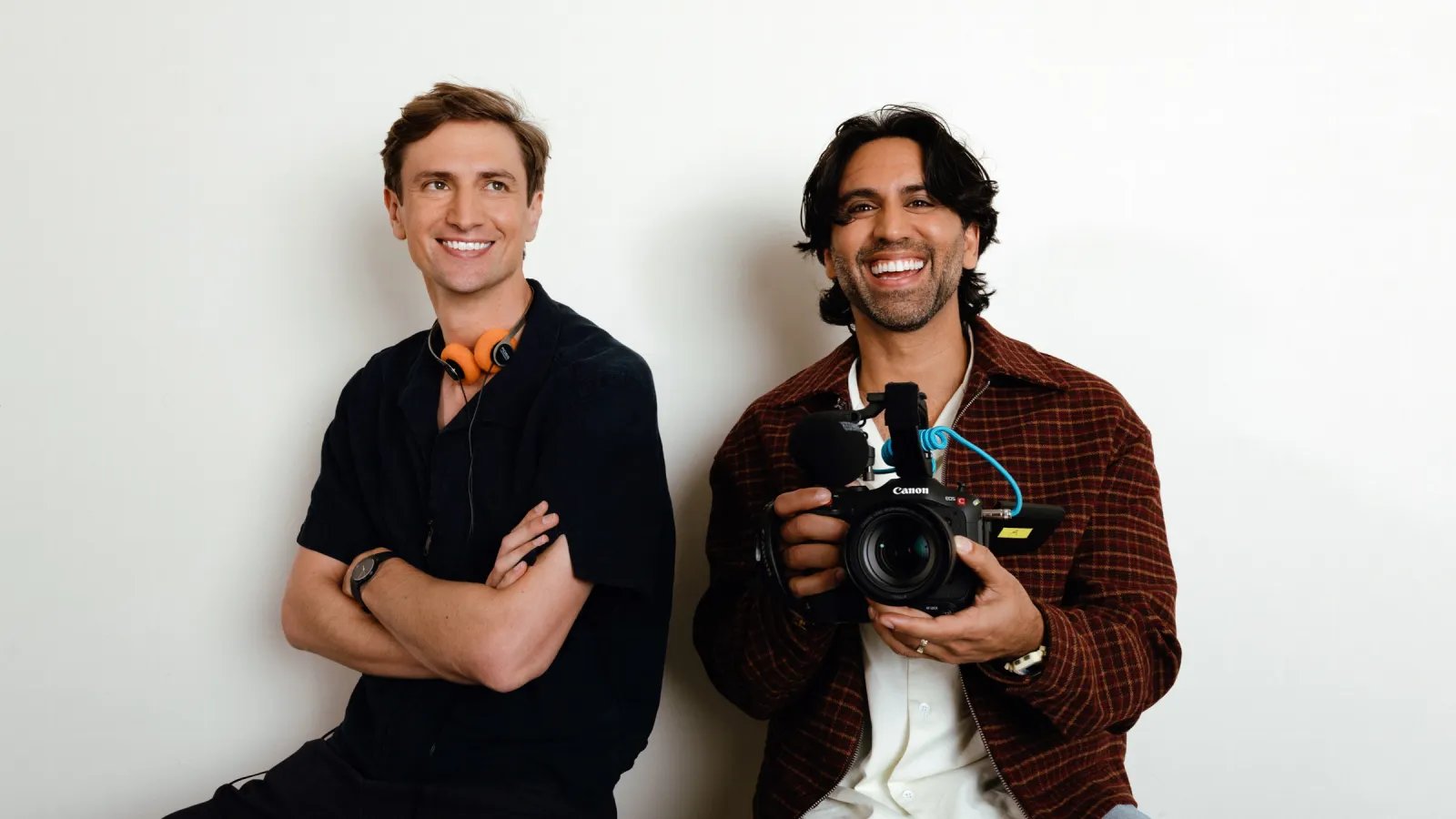
Rosenblum, left, helms the more creative aspects of their content, while Chaudry, right, focuses more on business.
Garrett Lobaugh
“Samir is more on the business side and I’m more on the creative side,” Rosenblum explains.
“One of the cleanest ways I could describe it is that my job is to build the canvas and Colin’s job is to paint on it,” Chaudry says, before pausing. “Maybe that’s actually too much of a metaphor? I bring more of the, ‘How is this actually going to be a thing that supports two 36-year-old guys? And Colin then takes where I want to go and fills it in creatively.”
Chaudry and Rosenblum have been business partners for a decade, but their journey to content creator experts started with an unlikely hobby: lacrosse. Chaudry grew up in Los Angeles to immigrant parents and was infatuated with American movies. After graduating from college, he worked as an assistant editor on the 2011 film The Ides of March, but left after realizing he wanted more control over what he was creating. It was early 2011, and Chaudry was focused on YouTube — a place where he felt like anyone could grow.
Chaudry had played lacrosse in high school and decided to launch the Lacrosse Network, a YouTube channel that would post multiple lacrosse shows and videos under one banner. “The way I thought about it was like a TV network,” he says. “We needed programming every single day, and I could only make a certain amount.” He searched online to see if anyone else was making content that might fit. “There was a trailer for a show uploaded to Vimeo about a Colorado club lacrosse team,” he says. “It felt like an MTV show about college students and they just so happened to play lacrosse. I reached out to the filmmaker — and that was Colin.”
A recent University of Colorado graduate, Rosenblum’s video about college lacrosse only had around 500 views when he got a message from Chaudry. But when he began releasing episodes on Chaudry’s channel, the videos began to grow an audience. After a few months, Chaudry offered Rosenblum an internship. “I thought it (would be) an interesting adventure, then maybe I’ll move back to the East Coast, where I’m from,” Rosenblum says. “Fifteen years later, I’m still here.”
In 2014, the channel was acquired by content-creator powerhouse Dude Perfect, which brought the pair on as consultants. “Exploring the world of Dude Perfect is what taught us what a creator looked like,” Chaudry says. “These are five guys who are making content for millions of people, but it’s just these five guys.” After four years at Dude Perfect, the two decided to branch out on their own. “We left with no plan outside of starting a channel called Colin and Samir.” he says. “We just want to express ourselves differently, and we want to participate in this new world of the creator economy.”
For a while it was a rough go. “We made some really bad videos in the next five years that nobody watched,” Chaudry says. In December 2019, they were roughly bringing in $26,000 each a year and viewership was stagnant. The two actually made a video titled “Goodbye,” announcing they would be shuttering the channel entirely. Rosenblum was so sure they were quitting that he packed his car and drove to New Jersey. Chaudry was applying for jobs. And then they got an email from Samsung.
The company offered them a year-long contract to be creator ambassadors for the brand, which was supposed to involve making branded content, testing products, and attending events. Rosenblum flew back to California, where they signed the deal. Days later, as most of the U.S. was dealing with the Covid-19 pandemic, they rented a studio in Venice, and began filming content, including their podcast about the creator economy. “That’s when the Colin and Samir brand really started to take shape,” Chaudry says.
Colin and Samir works because Rosenblum and Chaudry know how to talk to creators struggling to change what type of content they put out — because they did it. They know how to dissect viral trends, because they’ve seen them start. And instead of just commiserating, their content emphasizes just how important that failure was to their future success.
“One of the reasons we’ve been able to be successful is because we started this show as bad YouTubers who couldn’t figure it out, speaking to people who have figured it out,” Rosenblum explains. “While maybe we’ve never been really great YouTubers, we found that we are great at translating what makes someone else great.”
ON JAN. 7, 2025, ROSENBLUM and Chaudry were hosting a small conference for a few top creators with Spotter, a capital infusion fund for creators. The group was together in Big Sky, Montana, listening to a conversation between Rosenblum, Chaudry, and comedian Kevin Hart. One phone went off. Then several. Los Angeles was on fire.
Both of their wives were pregnant, so Rosenblum and Chaudry flew home the next day. On the way to the airport, Chaudry got a text. It was a video of his neighborhood covered in ash — and his home, completely burned to its foundation. “That’s when I found out,” Chaudry says. “(My wife) took one thing, a shoe box with our love letters, and that’s it. Life now, from a material perspective, starts at 36.” For Rosenblum, what was more difficult than the loss of material possessions was the budding sense of ownership that the fires burned away. “When I finally met my wife, and then we bought this home, it was the first indication to myself that I was (in LA) here to stay,” Rosenblum says. “This was a place where I was going to commit. And then when it burned down, it set me back to that time in my life.”
Rosenblum and Chaudry in one of the studios in the Venice Beach Lighthouse.
Garrett Lobaugh
While Rosenblum and Chaudry have literally gotten successful talking to people about their success, the two were in a rut before the fire. Creators want success, but going viral for one specific thing can burn them out if they try to replicate it, or turn what used to be a passion into a burden. The pair found themselves falling into this spot. Rosenblum and Chaudry tell me that prior to the fire, they were constantly aware that their channel wasn’t bringing in the views it did at the height of their success. (At one point, Chaudry flips his phone so I can see a literal graph of their views and followers, with a slowly sloping downward line.)
“At the end of 2024, I think I probably felt more fear than I’ve ever felt around my creativity. This terrifying feeling of, what if it all slips through my hands? I got everything I ever wanted, but what if I can’t hold on to it?” Chaudry says. “Then the fire happens. And you have this little boy looking at you, and I have to reckon that for me as a father, to get us out of this relies on my ability to make a great YouTube thumbnail.”
Rosenblum and Chaudry’s journey is so intertwined, both professionally and as friends, that is something Rosenblum often thinks about as well — and considers this a common problem creators face. “Fear is a terrible place to create from, and when you’ve lost confidence in yourself, you also lose the ability to take the right cues about what you care about and what you should be making,” Rosenblum says. “If you don’t know where to take your cues from, you end up lost.”
When their lives burned down, so did many of the mental holdups they had about what role their content played online — and what it could become. “From a viewership perspective, the landscape has changed. In 2023, we did 100 million views across the channel. Last year we did 40 million. It’s dramatically different. And I think we’ve tried a little bit to go, like, how do we get back there?” Chaudry says. “But the fact that I don’t have a choice to go back to the house that I built feels very symbolic. Now the only path is ‘What’s the next iteration of this?’”
It’s easy, then, to understand why Rosenblum and Chaudry have become especially focused on projects like the Lighthouse — those providing creators with a community they can rely on, especially in a solitary kind of business. (After the two fell in love with Listers, they interviewed Owen on the show.) Creators make their money online, but Rosenblum and Chaudry believe they only get stronger with in-person support. After the fire, their friends and former colleagues at Dude Perfect started a GoFundMe for Chaudry and Rosenblum, to allow them to find housing and deal with the costs of two destroyed homes. Then, in August, Chaudry and Rosenblum became partners in YouTube and the Entertainment Community Fund’s Fire Relief program, a $3 million reserve for YouTubers, creators, and entertainment professionals whose homes and careers were impacted by the fires.
Trending Stories
Right now their videos may have fewer views than they’re used to, and they batch content so the two can enjoy their kids’ new discoveries. But Chaudry says he’s not worried about the possibility of failure on the horizon. Success to him, is about being proud of the end result. And sometimes, it’s just a really good birding video.
“We might not make content anymore that 41 million people want to watch. I could probably do another listicle. But who cares? We’re in the business of producing memorable minutes,” Chaudry says. “Where I’m at 12 months after the fire is rebuilding everything about my life and everything about creativity to be present for the people who are there. And I’m thinking about producing memorable minutes for those people — and thinking about what the next 10 years can look like — a little corner at a time.”
Production Credits
Grooming by THEA ISTENES for Exclusive Artists using Augustinus Bader.
已发布: 2026-01-15 16:00:00