David Byrne brings love and a healthy dose of weirdness to Melbourne
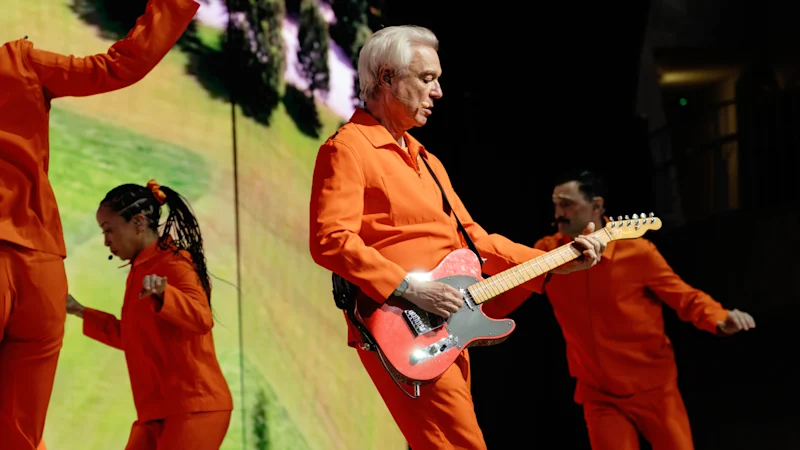
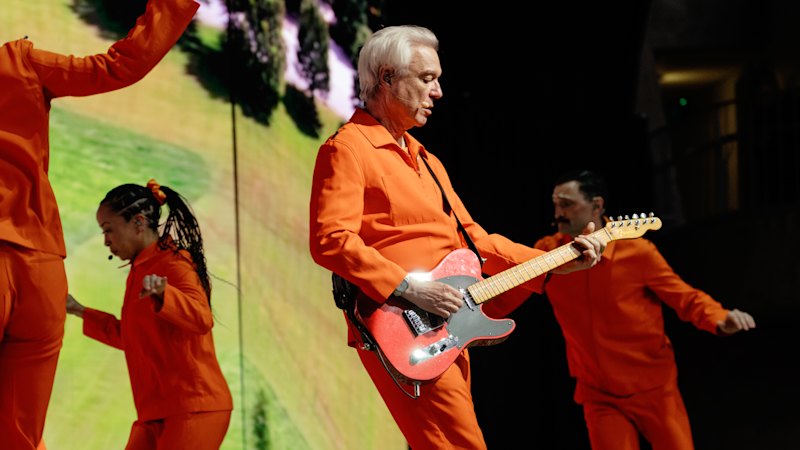
Updated January 26, 2026 — 11:43am,first published January 16, 2026 — 12:19pmSaveYou have reached your maximum number of saved items.Remove items from your saved list to add more.Save this article for laterAdd articles to your saved list and come back to them anytime.Got itAAAKey pointsMUSIC: David Byrne performs at Sidney Myer Music BowlTHEATRE: Burgerz at Malthouse Theatre is a remarkable work of performance artDANCE: This Nutcracker is the ballet equivalent of a fun-size chocolate bar.THEATRE: Tennis and theatre collide in Australian Open at Theatre Works CIRCUS: Circa offer a new spin on Swan Lake with their highly athletic Duck PondMUSICDavid Byrne ★★★★★Sidney Myer Music Bowl, January 22At his first Melbourne show since 2018, David Byrne shares a quote from director John Cameron Mitchell: “Love and kindness are the most punk things you can do.” Byrne was unsure of this at first – isn’t punk about anger? But then, on reflection, he agrees: “Love and kindness are indeed a form of resistance.”David Byrne performing at the Sidney Myer Music Bowl with his 12-strong crew of musicians and dancers, all dressed in orange boiler suits.
Richard CliffordByrne’s latest tour, off the back of his 2025 album, Who is the Sky?, combines politics and playfulness. Rising to fame as the esoteric frontman of new-wave legends Talking Heads, Byrne has moved, chameleonic, through ages and stages.He’s always shone as a live performer, using his weirdness as an artistic superpower: Talking Heads’ 1984 concert film, Stop Making Sense, provided a new blueprint for what live music could be; Byrne’s 2018 tour, American Utopia (later turned into a 2020 concert film directed by Spike Lee), injected commentary on Black Lives Matter and low voter turnout.In Melbourne, Byrne projects the image of the decapitated King George V statue to laughter and cheers; on T-Shirt, contemporary slogans flash up on the screen, with “Make America Gay Again” a crowd favourite. 1979’s Life During Wartime is more sobering – images of protests and ICE raids backdrop Byrne and his 12-strong crew of musicians and dancers, all dressed in orange boiler suits.At 73 Byrne is as energetic as ever, and his voice rings out, bell-clear, over the crowd. Clever lighting and design choices heighten the drama – the lights flash off for a beat in This Must Be the Place (Naive Melody), and a flashing rig turns Byrne and his crew into lightning rods themselves.David Byrne performing at the Sidney Myer Music Bowl on Thursday night.Richard CliffordThere are inspired arrangements here, breathing new life into old songs: opening number Heaven is gorgeously transformed with string accompaniment, and Psycho Killer – which Byrne has recently started performing live again for the first time in almost 20 years – blooms into a full-band rendition, arranged by the late composer Arthur Russell. There are throwbacks to Stop Making Sense in the arrangements and choreography of Houses in Motion and Slippery People.Byrne’s appeal is timeless, with young and old in attendance – he keeps up, too, covering Paramore’s Hard Times so convincingly you’d be forgiven for mistaking it for a Talking Heads B-side. It’s the classics that endure, though. By the time Once in a Lifetime and Burning Down the House roll around, there’s a sense of pure ecstasy in the air. Love, kindness and a healthy dose of weird – same as it ever was.Reviewed by Giselle Au-Nhien NguyenMUSICJames Muller Quartet ★★★★The JazzLab, January 25James Muller might be one of Australia’s finest jazz musicians, but opportunities to see the guitarist outside his home city of Adelaide are exceptionally rare. Muller did perform at last year’s Melbourne International Jazz Festival (as part of a project led by Linda May Han Oh), but it’s been years since he last appeared here leading a band of his own.And it’s been a full decade since he shared the stage with the players he considers his favourite bandmates in the country: trumpeter Mat Jodrell, bassist Sam Anning and Perth drummer Ben Vanderwal. So it’s no surprise that JazzLab was packed to the rafters on Sunday night, as Muller reassembled this Adelaide-Melbourne-Perth dream team to premiere a clutch of new compositions.Jazz musician James Muller took a while to get back to Melbourne with a band of his own, but the wait was worth it.Opening tune Blake set the scene – taut, theme-skipping and darting across a sea of choppy polyrhythms. Like many of the tunes we heard that night, it was a complex piece that kept the players – and the audience members – on their toes, requiring intense focus and impeccable precision.Jodrell’s role was especially demanding, his trumpet often mirroring Muller’s unpredictable lines as Anning’s bass and Vanderwal’s drums slithered and skittered beneath them. Yet somehow, the players never sounded tense or tentative. On the contrary, all four beamed with delight, clearly relishing one another’s musical company.Not every tune was a vigorous workout. Wishing Doll was warm and breezy, the leader’s eloquent guitar chiming in graceful tandem with Jodrell’s flugelhorn. And the night’s solitary ballad – Never Let Me Go – was gorgeously restrained, with delicate filigree from Muller and a wistfully lyrical solo from Anning.The final number saw the energy lift once more, the players grinning broadly as they engaged in virtuosic sparring over an ebullient theme. “See you in another 10 years!” joked Muller as the band left the stage, enveloped by the cheers of the crowd. Let’s hope it’s not that long.Reviewed by Jessica NicholasTHEATREBurgerz ★★★★Malthouse Theatre, until January 31The burger. It could be filled with anything, though it’s quintessentially beef. It could be a hot dog if it was presented differently, but that’d be something entirely separate. Customisable toppings add an element of experimentation, but the structural confines of what constitutes a burger remain.Travis Alabanza makes a burger from scratch on-stage in Burgerz.Dorothea TuchAre we still talking about burgers? Yes and no. British theatre maker Travis Alabanza has transformed the very thing that was hurled at them by a transphobic stranger in 2016 into the framework for a show questioning the strictures of gender and race, which they’ve been touring worldwide for the past eight years.To exert some control over the offending instrument, Alabanza has decided to make a burger from scratch – using a makeshift stove on a kitchen island – but they need help, something that was sorely missing when they were hate-crimed as 100 people watched on. But it can’t just be anyone. It has to be a white, cis, straight man (a tall order in a theatre crowd).In a surreal coincidence, the audience member called up on our night is also named Travis. The element of unpredictability in a show that predicates on spontaneous audience interaction, night after night, adds a frisson of danger, of unknowing.Alabanza launches into a litany of seemingly nonchalant yet incredibly pointed questions aimed at Travis. When was the last time he cried? Where does Australia’s racism stem from? Does he feel frightened by other men?Travis Alabanza in a scene from BurgerzDorothea TuchThis line of inquiry is invasive at times in the way it extracts a public performance of vulnerability, but in the discomfort that ensues, Alabanza is making a trenchant point. Travis consented to audience participation, and he is being assessed on the basis of a narrative that he has crafted himself. Alabanza doesn’t consent to being ogled, denigrated or given a wide berth when they’re in public spaces, and they’re denied their personhood and agency by the broad brushstrokes of bigotry.Like the onion that Travis so expertly slices into rings as he assists Alabanza, there are layers upon layers to this piece of performance art. Part stand-up, part cooking demonstration, part history lesson, part soliloquy, Alabanza switches effortlessly between different modes of storytelling and engagement. They are irreverent and quick-witted, with an uncanny command of the room – peals of laughter give way to pin-drop silence as Alabanza’s shifts the register from playful and slapstick to sombre to enraged. It’s akin to emotional whiplash.Related ArticleThe subject of their ire are the boxes – gestured towards literally in the set’s backdrop – that marginalise and suffocate people who don’t fit within society’s white, heteronormative confines.By inviting a foil onstage – who is, in every discernible way, their opposite – Alabanza projects their indignation and rage on to this person, who acts as both a receptacle and, because this is the Malthouse, a corrective to Alabanza’s experience of being assaulted with an airborne burger. In a moving display of solidarity, Travis bins the burger and offers Alabanza an (unreciprocated) hug before finally making his way offstage.Burgerz is strongest when it’s weaving disparate threads into striking commentary on being a trans person, all while pulling the rug out from under us.Culminating in a beautiful demonstration of safeguarding involving a tear-stricken front-row audience member, Alabanza adroitly shows us that the mutual duty we have to keep one another safe is the one thing that binds us all together.Reviewed by Sonia NairDANCEStorytime Ballet: The Nutcracker ★★★The Australian Ballet, Comedy Theatre, until January 25Is there time for one last holiday outing with the little ones? Why not try David McAllister’s breezy adaptation of The Nutcracker. Running at a mere 50 minutes, it’s the ballet equivalent of a fun-size chocolate bar: small, sweet and gone before you know it.The Nutcracker is a great introduction to ballet for children.Daniel BoudThis is ballet done as an interactive panto-style comedy for children as young as three. The kids can dress up in something sparkly, make a bit of noise, enjoy a few magic tricks and, best of all, see some proper dancing.Sean McGrath, as the genial magician-narrator, keeps the kids giggling and cheering. The youngsters wave glowing wands or waggle magic fingers to transform toys into life-sized dolls. Adults, of course, are required to join in – or the spell doesn’t work.In this stripped-back version, some of the mystery and enchantment inevitably goes missing. George Balanchine called The Nutcracker a ballet for children and adults who are children at heart. This version, however, will appeal mostly to the former.These annual Storytime concerts, produced by the Australian Ballet, are essentially a gentle introduction to ballet’s rituals, which carry their own strangeness and spell: when to clap, why nobody speaks and how the story and the dance politely disagree.The Nutcracker has plenty of dancerly moves to keep children entertained. Daniel BoudThe inclusivity and theatrical zoom of The Nutcracker suit this format. Yes, there is plenty of dancerly dazzle for aspiring ballerinas, but you also get toy soldiers wrestling with sword-wielding mice in scenes of cheerful mayhem.An ensemble of 12 dancers does the heavy lifting, with that sense of fun that matters most here. Still, there are lovely flourishes from Bronte Mollison, Alexander Mitchell and Claudia Gordon – crisp, bright, unshowy. Mostly, though, it’s an entertaining spectacle. The costumes stick to a traditional look, while the set is kept very simple, albeit softened by dreamy, colourful backdrops.Reviewed by Andrew FuhrmannTHEATREMIDSUMMA | Australian Open ★★★Theatre Works, until January 31A tennis match starts at love all, as we know, but off the court, should we love all, or only one person? The contest between monogamy and ENM (ethical non-monogamy) inspires an energetic rally at the start of Angus Cameron’s Australian Open, a queer domestic comedy that serves up aces of absurdity, rapid-fire volleys of wit, and heavy groundstrokes of camp and cringe, even if it does take a while to find its rhythm and play itself into form.Performers Melissa Kahraman, Eddie Orton and Sebastian Li in the show. Sarah ClarkeFelix (Sebastian Li) is thinking of marrying his tennis pro boyfriend of six years Lucas (Eddie Orton), and his bourgie parents Belinda and Peter (Jane Montgomery Griffiths and Alec Gilbert) are slightly appalled that their son and his partner might pursue an open marriage.An embarrassing game of doubles ensues as they banter and bicker and take turns fussing over “World No.3” Lucas – ignoring the fact it’s their son’s birthday – causing Felix to abandon the encounter before the set is out.Both couples are moved to imagine the grass might be greener. Stay-at-home dad Peter begins to wonder if he has repressed his attraction to men. All-conquering career woman Belinda feels the comfortable confines of married life might be preventing her from adventures scaled to her ambition – like, you know, climbing Mount Everest.Alec Gilbert with Eddie Orton in Australian Open. Sarah ClarkeThey decide on a trial separation to embrace radical self-discovery, while Felix and Lucas flirt with the idea (equally radical to them) of monogamy, tying themselves in knots over whether to tie the knot. Sibling rivalry enters the fray when Felix’s sardonic sister Anabelle – an experimental physicist living in Switzerland, who starts the play atop a referee’s chair – makes a surprise Christmas visit. She wants her parents to divorce; her brother is determined they should stay together.Ludicrous situational comedy unfolds as we get to the pointy end of the family farce, with daddy issues, vomit-inducing proposals and sexual fetish emerging in a satirical collision of the gay and the straight that delivers a kinky subversion of het-suburban mores, and questions received ideas about what’s normal for gay men into the bargain.Comic theatre design leans heavily into the gay tennis vibe – a cast dressed in athletic whites, the stage resembling a deconstructed play court under (what else?) a constellation of disco balls, and it’s flexible enough to evoke locales as diverse as gay clubs and the snowbound peaks of the Himalayas.Cameron’s social satire can feel a bit dated given cultural trends in the 2020s, from the enshittification of gay dating apps to the mainstreaming of ENM and “situationships”, as well as greater gender diversity and fetish of all kinds across the spectrum of sexual orientation.Sebastian Li as Felix and Alec Gilbert as his father, who begins to question his own sexuality.Sarah ClarkeThe performances could refine the timing and flow of the comedy, especially in clunky early scenes, and perhaps find a more precise relationship to caricature. Still, the more ridiculous the play becomes, the better the comic acting gets, with plenty of physical and verbal humour and laugh-out-loud outrageousness that should have audiences leaving on a high.Reviewed by Cameron WoodheadCIRCUSDuck Pond ★★★★Circa, Princess Theatre, until January 25Letting actual acrobats loose on the most sacred of ballet relics, Swan Lake, feels like the logical endpoint of a long-term trend in which ballet has come to resemble an extreme sport: an exhibition of uncanny flexion and vertiginous airtime.Duck Pond is an acrobatic reimagining of Swan Lake.Daniel BoudHardworking Brisbane circus company Circa offers nothing like a traditional retelling of the bewitched swan. Instead, this is a blithely impertinent mash-up: Odette as the Ugly Duckling, dreaming herself into a swan.Duck Pond opens at the prince’s birthday party, a full court of gentle gymnasts flipping, tumbling and vaulting into walkovers, then stacking on shoulders. The port de bras is impeccable, if port de bras now means balancing your mate on your head. Highlights include a startling four-high human tower, made all the more impressive in the Princess Theatre’s relative intimacy, and an aerial-silk act with Asha Colless holding a clean split before pitching forward into a core-straining horizontal line.The story barrels along. The Black Swan (Maya Davies) arrives and the Ugly Duckling (Sophie Seccombe) is shamed for her lack of glamour. A troupe of mop-wielding ducks try to console her, but it doesn’t work – like Charlie Curnow, she must become a swan.At the pond, in a sequence of roof-raising throws, the Duckling discovers that she, too, can soar. Jethro Woodward’s sound design is here at its most inventive, with a cool reworking of Tchaikovsky, swapping passion for quirky play.Overall, Duck Pond is a wonderfully polished take on modern circus.Daniel BoudIn the final act, Duck Pond takes a holiday turn as the fairytale ending is shoved aside. Instead of a wedding, the road cases are rolled in and the floor is torn up. Everything is stripped: both the stage and the performers. Well, no one’s actually nude, but some of the burlesque-flavoured business does skew older than you might expect for an all-ages show. The merriment ends with crowd-pleasing circus staples: hula-hoops and a Cyr wheel.Overall, it’s a wonderfully polished example of company director Yaron Lifschitz’s take on modern circus: a brisk dramatic premise that lets a youthful ensemble refresh some otherwise familiar routines.Reviewed by Andrew FuhrmannMUSICThe Last Dinner Party ★★★★Sidney Myer Music Bowl, January 15The stage is set with a patchwork of torn, off-white curtains, arches, a hanging bell and plenty of steps and levels for the band to pace and parade. And they do.The Last Dinner Party perform at Sidney Myer Music Bowl on January 15.Richard CliffordPreppy, bacchanalian baroque pop band The Last Dinner Party comprises five women and non-binary folks (and a guy on drums up the back) in velvet and lace, and armed with various audaciously shaped guitars, synths, a baby grand, a mandolin, a sax and enough charisma to carry off these melodramatic and infectious songs. It’s earnest glam rock. They know how to chew the scenery.Their recent second album, From The Pyre, is showcased here – a confident and ornate bunch of songs drawing on early Kate Bush and 1970s rock operatics.After opener (and highlight) Agnus Dei, we’re lifted through killer harmonies, playfully erudite lyrics and big solos in songs like Count the Ways, The Feminine Urge and I Hold Your Anger.In just a couple of years, The Last Dinner Party has released two albums and amassed an adoring fan base. They’re twenty-something, they skew female and queer, and they’re all in. They’re dressed up and equipped with tributes – flowers, signs, a homemade pair of angel wings – and the band gives back. Lead singer Abigail Morris even scrawls drawings on a few people in the front row, which they’ll go off and get tattooed.Abigail Morris of The Last Dinner Party.Richard CliffordBy the end of the set when they whip out their debut single and most enduring hit Nothing Matters and the very fun This Is the Killer Speaking, the crowd is fully locked in, even committing to choreography. Then they wrap it up with a brief reprise of Agnus Dei, like it’s all been one big musical spectacular.If you’re ever sitting down near the front at a show at the music bowl, turn around during a really big number and witness the crowd behind you. Pure joy.Reviewed by Will CoxThe Booklist is a weekly newsletter for book lovers from Jason Steger. Get it delivered every Friday.SaveYou have reached your maximum number of saved items.Remove items from your saved list to add more.Will Cox writes fiction and arts criticism. He’s based in Merri-bek.Sonia Nair is a contributor to The Age and Good Food.From our partners
已发布: 2026-01-26 00:43:00
来源: www.smh.com.au